
On this page
- What to do after a truck accident
- How to look up the carrier
- What is an ELD?
- Truck blind spots
- Federal hours-of-service limits
- Federal minimum insurance for trucks
- Records that may exist after a truck crash
- State pages: Tennessee, Alabama, Oklahoma, South Carolina
- Tennessee and Memphis truck data
- Questions
- Sources
Last verified November 9, 2026 against the eCFR, FMCSA pages and NHTSA FARS data cited below. The federal rules apply in all four launch states. Laws change; confirm on the official sites. Attorney review pending. CrashFirst is not a law firm.
What to do after a truck accident
The steps after a crash with a truck begin as they do after any crash: get medical care, call the police, and keep records. See what to do after a car accident. What is different with a commercial truck is the paper trail. Federal rules (below) require the carrier to keep driver logs, ELD data and an accident register, and the carrier's identity and safety record are public. An attorney can explain how those records apply to your facts. To get the police report, use the crash report finder.

How to look up the carrier
FMCSA runs a free tool called SAFER Web. Its Company Snapshot page says: "The Company Snapshot is a concise electronic record of a company" with its identification, size, commodity information, and safety record, "including the safety rating (if any), a roadside out-of-service inspection summary, and crash information." [10] It adds that the Snapshot "is available via an ad-hoc query (one carrier at a time) free of charge" and that users "can search by DOT Number, MC/MX Number or Company Name." [10] [10] The lookup is at safer.fmcsa.dot.gov. A snapshot is a record of a company, not a finding about any crash.
What is an ELD?
FMCSA describes an electronic logging device (ELD) this way: "An ELD synchronizes with a vehicle’s engine to automatically record a driver’s off-duty and on-duty time and securely transfer HOS data to a safety official." [8] The device records engine power status, vehicle motion status, miles driven, engine hours, identification of the driver, vehicle and motor carrier, and duty status [8]. FMCSA says the rule "does not change any of the basic hours-of-service rules or exceptions." [7]
What it does not do: "ELDs are not required to collect data on vehicle speed, braking action, steering function, or other vehicle performance parameters." [9] Location is approximate: the ELD records "the approximate distance and direction to an identifiable location corresponding to the name of a nearby city, town, or village," not a street address [9]. Which trucks do not need one is in the records table below.
Truck blind spots
FMCSA's driving-safely tip sheet says: "Large trucks and buses have huge blind spots – or No Zones – around the front, back and sides of the vehicle. If you can’t see the driver in the truck’s side mirror, assume that the driver can’t see you." [11] [11] It also warns that tailgating "puts you in a blind spot—or No Zone." [11]
Federal hours-of-service limits
The Federal Motor Carrier Safety Administration (FMCSA) limits how long truck drivers may drive. For drivers of property-carrying commercial vehicles, 49 CFR § 395.3 says:
| Limit | Rule |
|---|---|
| Driving time | A driver may drive a total of 11 hours after coming on duty following 10 consecutive hours off duty. |
| 14-hour window | Driving is not permitted after the 14th hour after coming on duty following 10 hours off duty. |
| 30-minute break | Driving is not permitted if more than 8 cumulative hours of driving have passed without at least a 30-minute interruption (off-duty, sleeper berth or on-duty not driving counts). Certain short-haul drivers are exempt. |
| 60/70-hour limit | No driving after 60 hours on duty in 7 consecutive days (carriers that do not operate every day) or 70 hours in 8 consecutive days (carriers that do). |
| 34-hour restart | A 7- or 8-day period can end with a break of 34 or more consecutive hours off duty. |
These are the baseline rules; exceptions exist (for example short-haul and adverse driving conditions) and are not covered here.
Federal minimum insurance for trucks
Federal rules set minimum financial responsibility for motor carriers (49 CFR § 387.9). The schedule's figures include:
| Type of carriage | Vehicle weight | Cargo | Federal minimum |
|---|---|---|---|
| For-hire, interstate or foreign commerce | 10,001+ lbs | Non-hazardous property | $750,000 |
| For-hire and private | 10,001+ lbs | Oil and certain hazardous materials | $1,000,000 |
| For-hire and private | 10,001+ lbs | Certain hazardous substances in bulk, bulk explosives, certain poison gases and radioactive materials | $5,000,000 |
For comparison, state minimums for an ordinary car are on each state's page: Tennessee, Alabama, Oklahoma and South Carolina. Which minimum applies to a specific truck depends on the vehicle, cargo and type of trip; the rule text sets out the details. Those are the minimums, not the amount of insurance a carrier actually has.
Records that may exist after a truck crash
| Record | What federal rules say | How long |
|---|---|---|
| Records of duty status (logs) and supporting documents | Carriers must keep each driver's records of duty status and supporting documents "for a period of not less than 6 months from the date of receipt." (49 CFR § 395.8(k)(1)) [3] | At least 6 months |
| Driver's recent log copies | Drivers must keep a copy of each record of duty status for the previous 7 consecutive days available for inspection while on duty (§ 395.8(k)(2)) | 7 days |
| Electronic logging device (ELD) data | Motor carriers "must install and require each of its drivers to use an ELD" [3], with limited exemptions (e.g., a driver who completes logs on not more than 8 days in a 30-day period; driveaway-towaway; vehicles made before model year 2000) (§ 395.8(a)(1)). An ELD automatically records date, time, location, engine hours, vehicle miles, and driver, vehicle and carrier identification (§ 395.26). Location is logged when moving at least once an hour and on events such as duty-status changes and engine start or stop. | Per the log retention rule above |
| Accident register | Motor carriers must keep a register of accidents for 3 years with date, city and state, driver name, number of injuries, number of fatalities, and whether hazardous materials were released, plus copies of government or insurer accident reports (49 CFR § 390.15(b)) | 3 years |
State pages: Tennessee, Alabama, Oklahoma, South Carolina
The federal rules above apply to interstate carriers in every state. The deadline, fault rule and crash-report steps for a truck crash are the same as for any crash in that state:
| State | Deadline | Fault rule | Police report |
|---|---|---|---|
| Tennessee | Tennessee deadlines | Tennessee fault rules | Crash report finder |
| Alabama | Alabama deadlines | Alabama contributory negligence | Crash report finder |
| Oklahoma | Oklahoma deadlines | Oklahoma fault rules | Crash report finder |
| South Carolina | South Carolina deadlines | South Carolina fault rules | Crash report finder |
This page does not state any state's truck size, weight or intrastate trucking rules; we did not read them. Hurt in a truck while working? See work crash: workers' comp vs. another driver.
Tennessee and Memphis truck data
We analyzed the National Highway Traffic Safety Administration's Fatality Analysis Reporting System (FARS) for Shelby County, 2015 to 2024. We counted a crash as involving a large truck if any vehicle in it has a FARS body-type code from 60 to 79. Counts show crashes with a large truck involved, not who caused them.
| Measure | 2015-2024, Shelby County |
|---|---|
| Fatal crashes | 1,755 |
| Fatal crashes involving a large truck | 166 (9%) |
| People killed in those 166 crashes | 186 |
| On interstates | 59 of 166 |
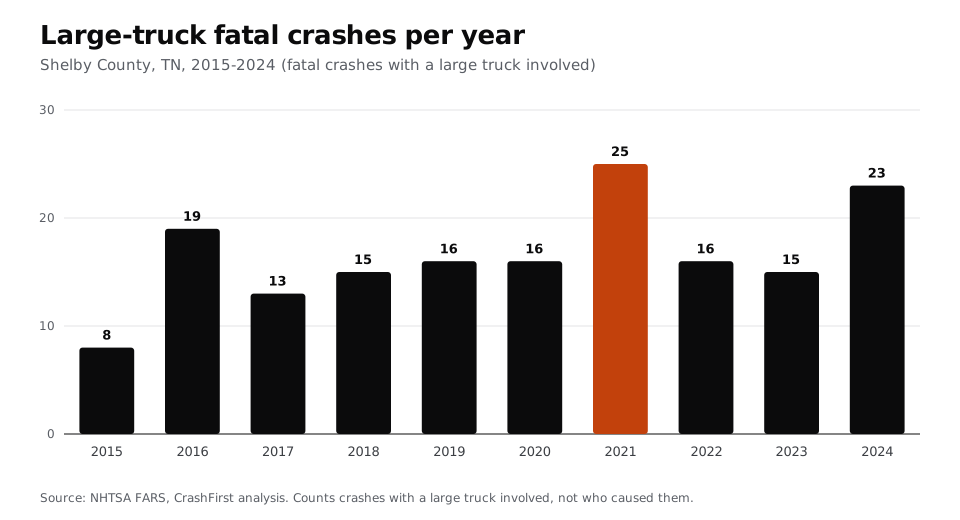
Large-truck fatal crashes by year ranged from 8 (2015) to 25 (2021); 2024 had 23. The chart shows exactly the counts in our data file.
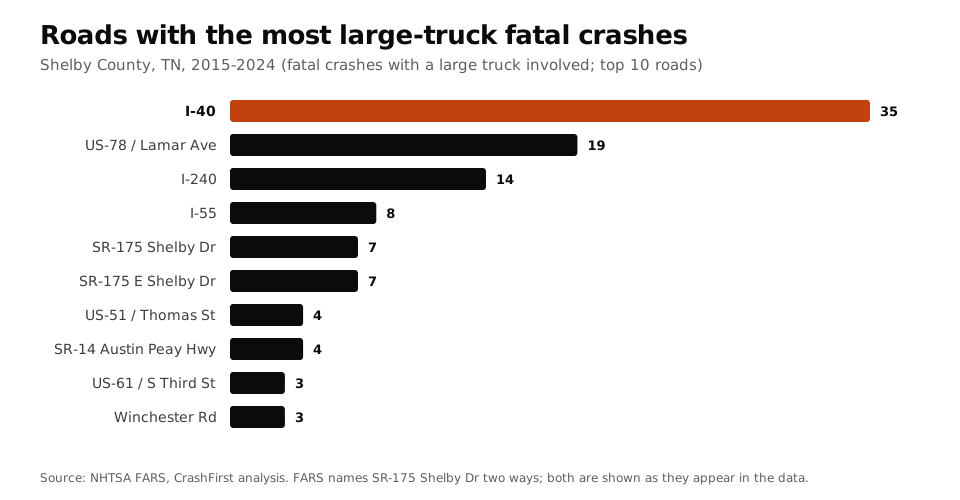
I-40 had the most (35), then US-78 / Lamar Avenue (19), I-240 (14) and I-55 (8). FARS records Shelby Drive (SR-175) under two road names, 7 crashes each, so combined it ties I-240 at 14. Source: NHTSA FARS, CrashFirst analysis; see the Memphis crash report.
Sources
- 49 CFR 395.3, hours of service (eCFR, current text) (checked November 9, 2026)Official source
- 49 CFR 387.9, minimum financial responsibility (eCFR) (checked November 9, 2026)Official source
- 49 CFR 395.8, records of duty status and ELDs (eCFR) (checked November 9, 2026)Official source“for a period of not less than 6 months from the date of receipt”“must install and require each of its drivers to use an ELD”“manufactured before model year 2000, as reflected in the vehicle identification number”
- 49 CFR 395.26, ELD data automatically recorded (eCFR) (checked November 9, 2026)Official source
- 49 CFR 390.15, accident register (eCFR) (checked November 9, 2026)Official source
- NHTSA Fatality Analysis Reporting System (FARS), 2015-2024 (checked November 9, 2026)Official source
- FMCSA: Electronic Logging Devices (checked November 9, 2026)Official source“The ELD final rule does not change any of the basic hours-of-service rules or exceptions”“congressionally mandated as a part of MAP-21”
- FMCSA ELD site: About ELDs (checked November 9, 2026)Official source“An ELD synchronizes with a vehicle’s engine to automatically record a driver’s off-duty and on-duty time and securely transfer HOS data to a safety official”“Engine power status”“Identification of driver/authorized user, vehicle, and motor carrier”
- FMCSA: ELD Functions FAQs (checked November 9, 2026)Official source“ELDs are not required to collect data on vehicle speed, braking action, steering function, or other vehicle performance parameters”“the approximate distance and direction to an identifiable location corresponding to the name of a nearby city, town, or village”
- FMCSA SAFER Web: Company Snapshot (checked November 9, 2026)Official source“identification, size, commodity information, and safety record, including the safety rating (if any), a roadside out-of-service inspection summary, and crash information”“is available via an ad-hoc query (one carrier at a time) free of charge”“Users can search by DOT Number, MC/MX Number or Company Name”
- FMCSA: Tips for Driving Safely Around Large Trucks or Buses (Our Roads, Our Safety) (checked November 9, 2026)Official sourceWhere: p.1, Rule 1 No-ZonesWhere: p.1, Rule 4 Stay Back
Page last updated November 9, 2026. Attorney review pending. General information, not legal advice. Fees, hours and rules change; confirm on the official page. How we source.
Questions
What is an ELD in trucking?
The FMCSA says an ELD synchronizes with a vehicle's engine to automatically record a driver's off-duty and on-duty time and securely transfer hours-of-service data to a safety official [8]. The rule requiring them came from Congress as part of MAP-21 [7]. ELD stands for electronic logging device.
What does an ELD record?
FMCSA's list: engine power status, vehicle motion status, miles driven, engine hours, identification of the driver, vehicle and motor carrier, and duty status [8]. FMCSA also says ELDs are not required to collect data on vehicle speed, braking action, steering function, or other vehicle performance parameters [9].
What year truck does not need an ELD?
Under 49 CFR § 395.8(a)(1)(ii)(A)(4), a motor carrier may require a driver to record duty status manually rather than use an ELD if the driver is operating a commercial motor vehicle that was manufactured before model year 2000, as reflected in the vehicle identification number shown on the registration [3]. Other exceptions in that paragraph cover drivers who need a record of duty status on not more than 8 days in a 30-day period and certain driveaway-towaway operations.
How can I look up a trucking company?
FMCSA's SAFER Company Snapshot is a concise electronic record of a company's identification, size, commodity information, and safety record, including the safety rating (if any), a roadside out-of-service inspection summary, and crash information, and it is free to query one carrier at a time [10]. You can search by DOT Number, MC/MX Number or Company Name [10].
Where are the blind spots on a truck?
FMCSA says large trucks and buses have huge blind spots, or No Zones, around the front, back and sides of the vehicle, and that if you cannot see the driver in the truck's side mirror, you should assume the driver cannot see you [11] [11].
How many people died in truck crashes in Memphis?
In our count of NHTSA FARS data for Shelby County, 2015 to 2024, 166 of 1,755 fatal crashes involved a large truck and 186 people died in those 166 crashes. FARS counts fatal crashes only, and counts a crash as involving a large truck whether or not the truck driver was at fault. See the Memphis data section below. We did not compile a national count.
How many hours can a truck driver drive?
Under 49 CFR § 395.3, 11 hours of driving within a 14-hour window after 10 hours off duty, with a 30-minute break after 8 cumulative driving hours, and 60 or 70 hours on duty in 7 or 8 days.
What is the minimum insurance for a commercial truck?
The federal minimum in 49 CFR § 387.9 is $750,000 for for-hire carriers of non-hazardous property in interstate commerce with vehicles over 10,000 pounds, and $1,000,000 or $5,000,000 for certain hazardous cargo.
Do trucks have black boxes?
Federal rules require most carriers to use an electronic logging device (ELD) that automatically records date, time, location, engine hours, vehicle miles and driver, vehicle and carrier identification. What else a particular truck recorded is a question for the carrier and the vehicle's manufacturer.
How long do carriers keep logs?
At least 6 months for records of duty status and supporting documents; 3 years for the accident register.
CrashFirst is not a law firm and does not give legal advice. This checklist is general information. Every situation is different.
Keep reading
- City guide
Most dangerous roads in Memphis: where fatal crashes happen
Which Memphis roads had the most fatal crashes 2015-2024: I-240, I-40, Shelby Dr and more. Times, pedestrians, charts and a free CSV from NHTSA and TITAN data.
Open - State reference
How long do you have to file after a car accident in Tennessee?
Tennessee gives one year for most injury claims after a crash. See each deadline, the statute text, exceptions and a Memphis court ruling. Checked Nov 2026.
Open - State reference
Alabama statute of limitations for car accident injury claims
Alabama gives two years for most car accident injury claims and two years for wrongful death. Exact statute text, exceptions and city-claim notice rules.
Open - State reference
Oklahoma statute of limitations for car accident injury claims
Oklahoma gives two years for most injury claims after a crash and for wrongful death. Exact statute text, the one-year government claim rule and exceptions.
Open - State reference
South Carolina statute of limitations for car accident injury claims
South Carolina gives three years for most injury claims after a crash, counted from when you knew of the claim. Exact statute text, wrongful death and government claims.
Open - State reference
Is Tennessee a comparative fault state?
Tennessee uses modified comparative fault: recover if your share is less than the other side's, reduced by your percentage. McIntyre v. Balentine explained.
Open