
The short answer
How many people die in bicycle accidents
NHTSA reports 1,166 pedalcyclists killed in U.S. traffic crashes in 2023, 2.9 percent of all traffic deaths [12]. Our count of every bicyclist death in the FARS files is 9,535 over 2015 to 2024. These are deaths only; NHTSA estimated 49,989 pedalcyclists were injured in 2023 [12].
This page reports the laws as written and the federal numbers. It does not say who is at fault in any crash.

The laws
Bicycle laws in four states
Each state treats a person riding on a roadway like the driver of a vehicle, with special rules for bicycles. Below are the main provisions as written. Tennessee text is as reproduced by FindLaw, current as of January 2, 2024; the others were read on the legislature or court-network sites on November 9, 2026. Cities may add their own rules, and e-bikes have separate rules we do not cover here.
Tennessee
- Rights and duties. A person riding a bicycle on a roadway "is granted all of the rights and is subject to all of the duties applicable to the driver of a vehicle," except provisions that by their nature cannot apply [1].
- Where to ride. A bicyclist going slower than traffic must "ride as close as practicable to the right-hand curb or edge of the roadway," with exceptions such as passing, preparing for a left turn, or avoiding hazards including a lane too narrow to share [2]. No more than two abreast [2].
- Passing distance. A motor vehicle passing a bicycle in the same direction "shall leave a safe distance between the motor vehicle and the bicycle of not less than three feet." [2] A violation is a Class C misdemeanor [2].
- Helmets. It is unlawful for "any person under sixteen (16) years of age to operate or be a passenger on a bicycle" without a protective helmet [3].
Alabama
- Rights and duties. A person riding a bicycle on a roadway "shall be granted all of the rights and shall be subject to all of the duties applicable to the driver of a vehicle." [4]
- Where to ride. Ride "as near to the right side of the roadway as practicable," no more than two abreast [5]. Where a usable path for bicycles is adjacent to a roadway, riders "shall use such path and shall not use the roadway." [5]
- Passing distance. When passing a bicycle, a safe distance means "not less than three feet" on a roadway with a marked bicycle lane, or on one with a speed limit of 45 mph or less and no double yellow line [6]. That rule applies "only when a cyclist is riding within two feet of the right shoulder of the roadway." [6]
- Helmets. The bicycle safety article requires "all operators and passengers who are under 16 years of age to wear approved protective bicycle helmets." [7]
Oklahoma
- Rights and duties. A person riding a bicycle on a roadway "shall be granted all of the rights and shall be subject to all of the duties applicable to the driver of a vehicle by this title." [8]
- Where to ride. A bicyclist going slower than traffic must "ride as close as is safe to the right-hand curb or edge of the roadway," with listed exceptions [9].
- Passing distance. On a one-lane road, a driver "shall not overtake or pass a bicycle at a distance of less than three (3) feet between any part of the motor vehicle and any part of the bicycle or its operator." [10] With more than one lane the driver moves to the lane to the left if available and reasonably safe [10].
South Carolina
- Rights and duties. A person riding a bicycle on a roadway "must be granted all of the rights and is subject to all of the duties applicable to the driver of a vehicle." [11]
- Bicycle lanes. Where a bicycle lane is provided, drivers "may not block the bicycle lane to oncoming bicycle traffic and shall yield to a bicyclist in the bicycle lane before entering or crossing the lane," and bicyclists must ride in the lane except to pass or avoid an obstruction [11] [11].
- Where to ride. Ride "as near to the right side of the roadway as practicable," and the rider may but need not use the shoulder [11].
- Passing distance. South Carolina sets no number of feet: a driver "must at all times maintain a safe operating distance between the motor vehicle and a bicycle." [11]
For helmets, Oklahoma and South Carolina: we did not find a statewide bicycle helmet statute in the sections we read, and we do not say none exists. Who is at fault in a crash depends on the facts and on each state's fault rules; an attorney can explain how they apply to you. In the District of Columbia, a bicyclist hit by a motor vehicle is not barred by their own negligence unless it is greater than the defendants' combined; see the fault table. See also pedestrian accidents.
By year
Bicyclist deaths by year
We counted people with person type "Bicyclist" or "Other Cyclist" and injury severity "Fatal Injury" in the FARS national files. NHTSA describes FARS as "a nationwide census providing NHTSA, Congress and the American public yearly data regarding fatal injuries suffered in motor vehicle traffic crashes." [14] From 2022, NHTSA's category includes riders of motorized bicycles [12].
| Year | Bicyclist deaths |
|---|---|
| 2015 | 829 |
| 2016 | 853 |
| 2017 | 806 |
| 2018 | 871 |
| 2019 | 859 |
| 2020 | 948 |
| 2021 | 976 |
| 2022 | 1,117 |
| 2023 | 1,173 |
| 2024 | 1,103 |
| 2015-2024 | 9,535 |
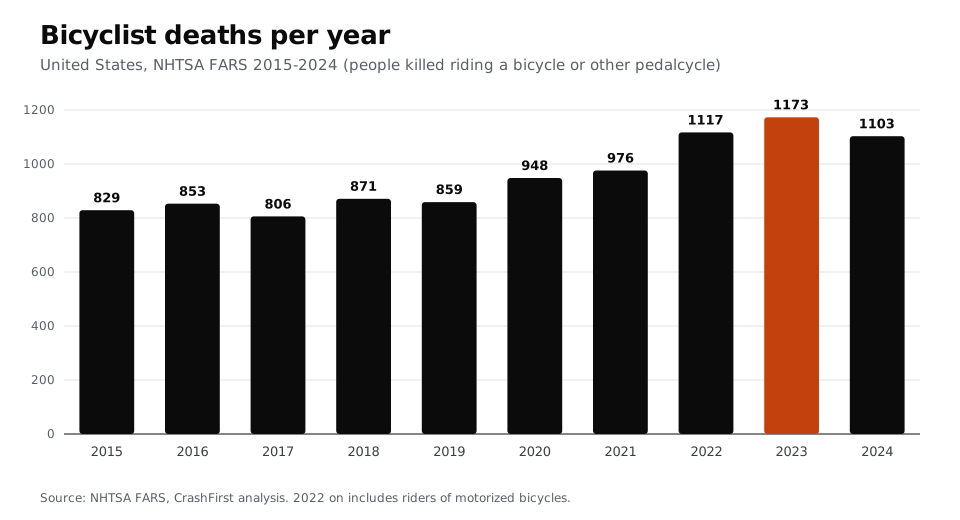
Our counts for 2015 to 2022 match NHTSA's published table. For 2023 we count 1,173 against NHTSA's 1,166, because NHTSA's fact sheet covers pedalcyclists killed in crashes involving motor vehicles in transport [12]. IIHS's 2024 figure of 1,075 is also crashes with motor vehicles [13]. IIHS calls that the third-highest number ever recorded. The chart shows exactly the counts in our data file.
By state
Which states have the most bicyclist deaths
| Rank | State | Deaths 2015-2024 | Deaths 2024 |
|---|---|---|---|
| 1 | Florida | 1,767 | 208 |
| 2 | California | 1,511 | 163 |
| 3 | Texas | 757 | 79 |
| 4 | New York | 428 | 47 |
| 5 | Arizona | 362 | 44 |
| 11 | South Carolina | 228 | 34 |
| 21 | Oklahoma | 111 | 11 |
| 25 | Tennessee | 97 | 9 |
| 29 | Alabama | 85 | 10 |
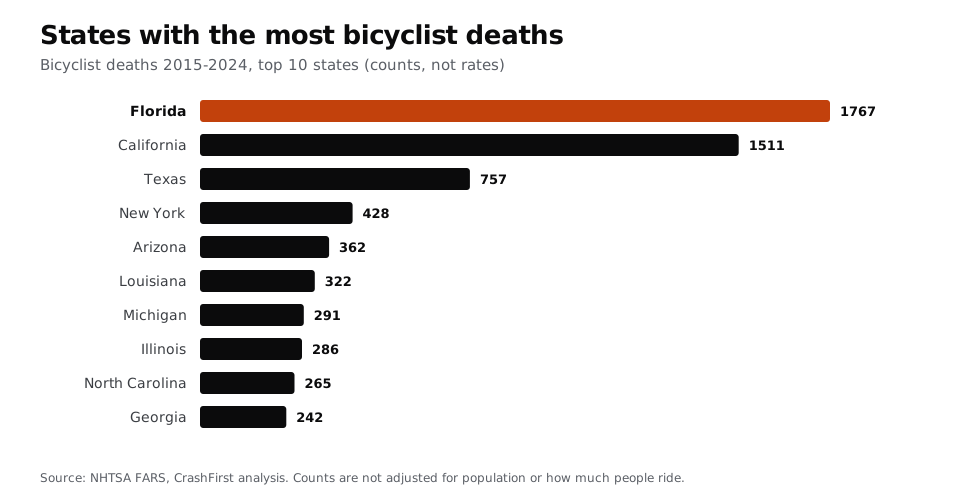
The full list for all states is in our data file. Source: NHTSA FARS, CrashFirst analysis.
These are counts. A big state with many riders will have more deaths than a small one, so counts do not show where riding is most dangerous. That takes a rate, which needs a population. NHTSA publishes 2023 rates per 100,000 people:
| State (2023) | Deaths | Rate per 100,000 |
|---|---|---|
| Florida | 234 | 1.03 |
| South Carolina | 25 | 0.47 |
| Oklahoma | 15 | 0.37 |
| Alabama | 10 | 0.20 |
| Tennessee | 11 | 0.15 |
| United States | 1,166 | 0.35 |
Source: NHTSA Table 6, 2023 FARS and Census population [12] [12] [12] [12]. NHTSA says Florida had the highest rate, then Louisiana (0.77), against a national rate of 0.35 [12]. Rates per rider, which would account for how many people cycle, are not available from these sources.
Where and when
Where and when fatal bicycle crashes happen
For each bicyclist death in 2015 to 2024 we looked up the crash record. Source: NHTSA FARS, CrashFirst analysis; counts are in the circumstances file.
| Circumstance | Share of 9,535 deaths |
|---|---|
| Urban area | 79.3% |
| Rural area | 20.3% |
| Not at a junction | 56.5% |
| At an intersection | 19.6% |
| Intersection-related | 17.5% |
| Daylight | 46.0% |
| Dark, with street lighting | 25.2% |
| Dark, no street lighting | 22.7% |
| Dawn or dusk | 4.5% |
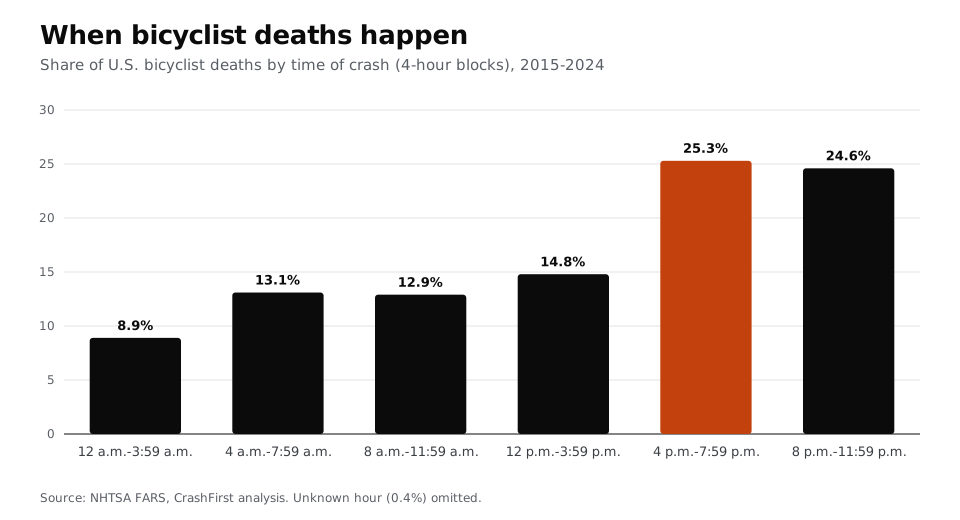
The two evening blocks, 4 p.m. to midnight, hold about half of all deaths (25.3% and 24.6%). NHTSA's 2023 figures point the same way: 53 percent of pedalcyclist deaths occurred in the dark and 42 percent in daylight [12]. NHTSA also reports that pedalcyclists killed in single-vehicle crashes were most likely to be struck by the front of the vehicle [12].
What to do after one
After a bicycle crash
IIHS reports that in a majority of bicyclist deaths the most serious injuries are to the head [13]. Lawsuit deadlines differ by state: use the deadline calculator. The longer checklist is on what to do after a car accident.
Want to talk it through? A person usually calls you back in about 15 minutes (8am to 8pm Central). You never pay CrashFirst. CrashFirst is not a law firm, does not evaluate your crash and does not give legal advice. General information as of November 9, 2026.
Sources
- Tenn. Code Ann. § 55-8-172, bicycle rights and duties (FindLaw mirror, current as of Jan. 2, 2024) (checked November 9, 2026)Code text via FindLaw (unofficial copy)“granted all of the rights and is subject to all of the duties applicable to the driver of a vehicle”
- Tenn. Code Ann. § 55-8-175, riding on roadways, passing distance (FindLaw mirror) (checked November 9, 2026)Code text via FindLaw (unofficial copy)“ride as close as practicable to the right-hand curb or edge of the roadway”“shall not ride more than two (2) abreast”“shall leave a safe distance between the motor vehicle and the bicycle of not less than three feet”“A violation of this section is a Class C misdemeanor”
- Tenn. Code Ann. § 55-52-105, bicycle helmets (FindLaw mirror) (checked November 9, 2026)Code text via FindLaw (unofficial copy)“any person under sixteen (16) years of age to operate or be a passenger on a bicycle”
- Code of Alabama § 32-5A-260, traffic laws apply to bicycles (Alabama Legislature) (checked November 9, 2026)Official source“shall be granted all of the rights and shall be subject to all of the duties applicable to the driver of a vehicle”
- Code of Alabama § 32-5A-263, riding on roadways and bicycle paths (Alabama Legislature) (checked November 9, 2026)Official source“shall ride as near to the right side of the roadway as practicable”“bicycle riders shall use such path and shall not use the roadway”
- Code of Alabama § 32-5A-82, overtaking on the left, bicycle passing distance (Alabama Legislature) (checked November 9, 2026)Official source“a safe distance shall mean not less than three feet”“shall only apply when a cyclist is riding within two feet of the right shoulder of the roadway”
- Code of Alabama § 32-5A-282, bicycle helmet purpose (Alabama Legislature) (checked November 9, 2026)Official source“all operators and passengers who are under 16 years of age to wear approved protective bicycle helmets”
- 47 O.S. § 11-1202, traffic laws apply to bicycles (Oklahoma State Courts Network) (checked November 9, 2026)Official source“shall be granted all of the rights and shall be subject to all of the duties applicable to the driver of a vehicle by this title”
- 47 O.S. § 11-1205, riding on roadways (Oklahoma State Courts Network) (checked November 9, 2026)Official source“shall ride as close as is safe to the right-hand curb or edge of the roadway”
- 47 O.S. § 11-1208, overtaking bicycles (Oklahoma State Courts Network) (checked November 9, 2026)Official source“shall not overtake or pass a bicycle at a distance of less than three (3) feet between any part of the motor vehicle and any part of the bicycle or its operator”“a motorist passing a cyclist shall move the vehicle to the lane to the immediate left if the lane is available”
- S.C. Code §§ 56-5-3420, 56-5-3425, 56-5-3430, 56-5-3435 (South Carolina Legislature, Title 56, Chapter 5) (checked November 9, 2026)Official source“must be granted all of the rights and is subject to all of the duties applicable to the driver of a vehicle”“may not block the bicycle lane to oncoming bicycle traffic and shall yield to a bicyclist in the bicycle lane before entering or crossing the lane”“bicycles are required to ride in the bicycle lane except when necessary to pass another person riding a bicycle or to avoid an obstruction in the bicycle lane”“shall ride as near to the right side of the roadway as practicable”“must at all times maintain a safe operating distance between the motor vehicle and a bicycle”
- NHTSA, Traffic Safety Facts: Bicyclists and Other Cyclists, 2023 Data (DOT HS 813 739) (checked November 9, 2026)Official sourceWhere: p.1, 1,166 fatalities, 2.9%Where: p.1, 49,989 injuredWhere: p.1, definition of pedalcyclistWhere: p.1, scope of fact sheetWhere: Table 6, p.10, South Carolina rowWhere: Table 6, p.10, Oklahoma rowWhere: Table 6, p.10, Alabama rowWhere: Table 6, p.10, Tennessee rowWhere: p.8, highest rate FloridaWhere: p.5, dark 53%Where: p.7, struck by frontWhere: p.2, 1,166 killedWhere: p.1, 34% alcoholWhere: p.1, 22% BAC .01+Where: p.4, Alcohol sectionWhere: p.5, urban 81%Where: p.5, non-intersection 62%Where: p.8, state highs
- IIHS, Fatality Facts 2024: Bicyclists (checked November 9, 2026)Official source“A total of 1,075 bicyclists were killed in crashes with motor vehicles in 2024”“In a majority of bicyclist deaths, the most serious injuries are to the head”
- NHTSA, Fatality Analysis Reporting System (FARS), 2015-2024 national files (checked November 9, 2026)Official source“FARS is a nationwide census providing NHTSA, Congress and the American public yearly data regarding fatal injuries suffered in motor vehicle traffic crashes”
Unofficial copies come from a legal publisher, not the state. They can lag the current code, so check the official code before relying on a date or amount.
Page last updated November 9, 2026. Attorney review pending. General information, not legal advice. Fees, hours and rules change; confirm on the official page. How we source.
Questions
How many people died in bicycle accidents every year?
NHTSA reports 1,166 pedalcyclists killed in U.S. traffic crashes in 2023 [12]. IIHS counts 1,075 bicyclists killed in crashes with motor vehicles in 2024 [13]. Our count of every bicyclist death in the FARS files is 1,103 for 2024; the three figures differ because they include different crashes. The table on this page lists every year from 2015 to 2024.
What is the leading cause of bicycle deaths?
The federal sources we read do not name a single leading cause. NHTSA reports what the data show instead: for example, 34 percent of fatal pedalcyclist crashes in 2023 involved alcohol (a blood alcohol concentration of .01 or higher) for the driver, the pedalcyclist or both, and 22 percent of the pedalcyclists killed had such a level [12] [12]. NHTSA says alcohol presence may or may not have contributed to a crash [12].
Where do most fatal bicycle accidents occur?
In cities and away from intersections. NHTSA reports that 81 percent of 2023 pedalcyclist deaths were in urban areas, 62 percent at locations that were not intersections and 28 percent at intersections [12] [12]. Our count of FARS records for 2015 to 2024 is similar: 79.3% urban, and 56.5% not at a junction.
Which state has the most bicycle deaths?
Florida, by count. NHTSA reports pedalcyclist deaths were highest in Florida (234), followed by California (145) and Texas (106) in 2023 [12]. Over 2015 to 2024 our FARS count is Florida 1,767, California 1,511 and Texas 757. Counts are not rates: NHTSA's population-based 2023 rate was also highest in Florida, 1.03 per 100,000 people [12].
What happens if a bicycle hits a car?
The statutes in all four states treat a person riding a bicycle on a roadway like the driver of a vehicle: they have the same rights and the same duties, except for special bicycle rules [1]. What happens after a particular crash, including fault and insurance, depends on the facts and the state. An attorney can explain how the law applies to yours.
CrashFirst is not a law firm and does not give legal advice. This checklist is general information. Every situation is different.
Keep reading
- Guide
What to do if you are hit by a car while walking
Pedestrian and driver rules at crosswalks in Tennessee, Alabama, Oklahoma and South Carolina as the statutes read, pedestrian deaths by state from federal data, and the Memphis numbers.
Open - Guide
What to do after a motorcycle accident
What to do after a motorcycle accident, helmet laws as written in Tennessee, Alabama, Oklahoma and South Carolina, lane rules, and motorcyclist deaths by state from federal data.
Open - Guide
What to do after a crash.
A calm, ordered checklist for the scene, today, the next 72 hours and the next few weeks. Tick it off here or print it for the glove box.
Open - Guide
What to do after a hit and run
Driver duties after a crash in Tennessee, Alabama, Oklahoma and South Carolina as the statutes read, who to report to, how uninsured motorist coverage treats a driver who left, and a checklist.
Open - Guide
Headache, concussion and TBI after a car accident: what health sources say.
What the CDC, NINDS and MedlinePlus say about headache, concussion and traumatic brain injury after a crash: symptoms, danger signs and when to get care.
Open - Tool
Find your crash report.
Pick where the crash happened in Memphis, Birmingham, Tulsa or Columbia to see which agency likely has your report and how to request it. Each row shows its source.
Open