
The short answer
Contributory vs comparative negligence
Under contributory negligence, a plaintiff who is at all negligent cannot recover [1]. Under comparative negligence, a court reduces the damages a plaintiff can recover according to each party's degree of negligence [2]. Comparative rules come in a pure form and in modified forms that still bar a plaintiff above a fault threshold. CrashFirst gives general information only and cannot tell you which rule applies to your crash.

Definitions
The terms, in plain words
- Contributory negligence. A common-law tort rule that bars plaintiffs from recovering for others' negligence if they were also negligent in causing the harm [1].
- Comparative negligence. The court may assign a percentage of fault to the injured person and the defendant [2]. A plaintiff 40% at fault, with a defendant 60% at fault, may recover 60% of the damages in Cornell's example [2].
- Pure comparative. The plaintiff may recover whatever share the defendant is responsible for, however large the plaintiff's own share. California's Supreme Court described the form as one where liability in proportion to fault proceeds even if the plaintiff is equally or more at fault than the defendant [7].
- Modified comparative. Cornell lists a 50 percent bar rule (no recovery at 50% or more at fault) and a 51 percent bar rule (no recovery at 51% or more) [2] [2]. Our table groups states by what the statute or decision says, not by these labels alone.
- Negligence per se. Negligence in itself: violating a statute or regulation without an excuse can establish a breach of duty as a matter of law [3]. It is a different idea from the fault-sharing rules above.
- Elements of a negligence claim. In Cornell's summary, a plaintiff proves that the defendant owed a duty, breached it, and the plaintiff suffered harm due to the breach [1].
Map
Fault systems by state
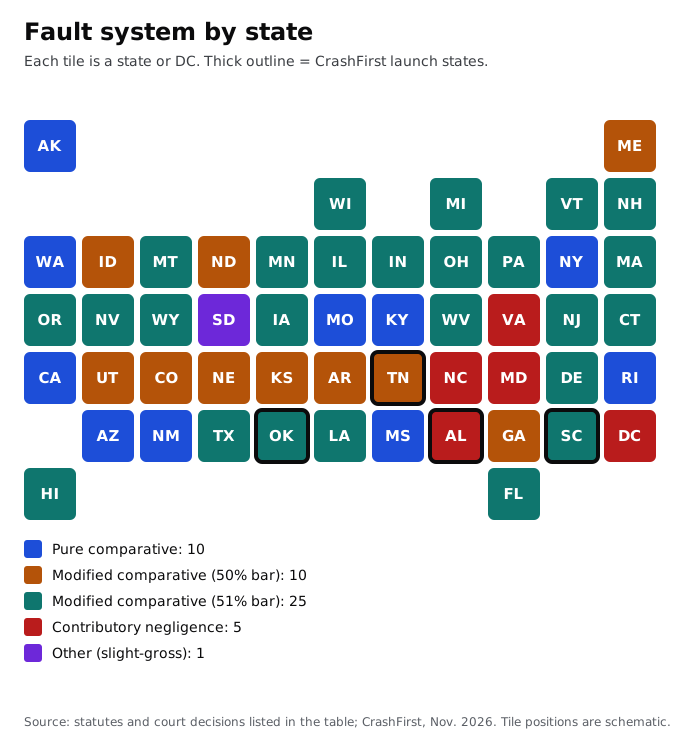
Our four launch states: Tennessee uses a modified rule (Tennessee fault rules), Alabama a complete bar (Alabama contributory negligence), Oklahoma a modified rule that, on our reading of the statute's words, bars recovery above 50% (Oklahoma fault rules) and South Carolina a modified rule that, on our reading of the court's words, does the same (South Carolina fault rules). Neither reading is confirmed by a court decision we read, and an attorney can confirm how courts apply them. Each is sourced in the table.
The table
State-by-state table
Each row names the statute or court decision we read, and quotes it. The "System" column is CrashFirst's grouping of what the quoted text says: for example, "not greater than" the other party's negligence means a plaintiff is barred only if greater (51% bar), while "not as great as" means a plaintiff at an equal share is barred (50% bar). Court decisions can be superseded by statutes and the reverse, and we did not search for later changes. Where a row relies on a FindLaw mirror it is marked in the source list, not the official code site.
| State | System | Rule as written | Authority |
|---|---|---|---|
| Alabama | Contributory negligence | Complete bar | Norfolk Southern Railway Co. v. Johnson, 75 So. 3d 624 (Ala. 2011) [4] |
| Alaska | Pure comparative | No bar; damages diminished in proportion to claimant's fault | AS 09.17.060 [45] |
| Arizona | Pure comparative | No bar; damages reduced by claimant's share of fault | A.R.S. § 12-2505 [5] |
| Arkansas | Modified comparative (50% bar) | Barred if claimant's fault is equal to or greater | Ark. Code § 16-64-122 (FindLaw mirror) [6] |
| California | Pure comparative | No bar; liability in proportion to fault | Li v. Yellow Cab Co., 13 Cal. 3d 804 (1975) [7] |
| Colorado | Modified comparative (50% bar) | Barred if claimant's negligence is as great as the defendant's | C.R.S. § 13-21-111 (FindLaw mirror, current as of Jan. 1, 2025) [8] |
| Connecticut | Modified comparative (51% bar) | Barred if claimant's negligence is greater than the combined negligence of the others | Conn. Gen. Stat. § 52-572h(b) [9] |
| Delaware | Modified comparative (51% bar) | Barred if claimant's negligence is greater than the defendants' | 10 Del. C. § 8132 [10] |
| District of Columbia | Contributory negligence | Complete bar | Wingfield v. Peoples Drug Stores, Inc., 379 A.2d 685 (D.C. 1977) [11] |
| District of Columbia (pedestrians and vulnerable users) | Contributory negligence | Exception for pedestrians and vulnerable users hit by a motor vehicle: barred only if claimant's negligence is greater than the defendants' combined | D.C. Code § 50-2204.52(a) [55] |
| Florida | Modified comparative (51% bar) | Negligence actions: no recovery if claimant is greater than 50 percent at fault (2023 change; medical negligence excepted) | Fla. Stat. § 768.81(6) [12] |
| Georgia | Modified comparative (50% bar) | Barred if claimant is 50 percent or more responsible | O.C.G.A. § 51-12-33(g) (FindLaw mirror, last updated March 28, 2024) [46] |
| Hawaii | Modified comparative (51% bar) | Barred if claimant's negligence is greater than the defendants' aggregate | HRS § 663-31 [47] |
| Idaho | Modified comparative (50% bar) | Barred if claimant's negligence is as great as the defendant's | Idaho Code § 6-801 [13] |
| Illinois | Modified comparative (51% bar) | Barred if claimant's fault is more than 50% | 735 ILCS 5/2-1116 [14] |
| Indiana | Modified comparative (51% bar) | Barred if claimant's fault is greater than all others' | Ind. Code § 34-51-2-6 (FindLaw mirror) [15] |
| Iowa | Modified comparative (51% bar) | Barred if claimant's fault is greater than the combined fault of the others | Iowa Code § 668.3 [16] |
| Kansas | Modified comparative (50% bar) | Barred if claimant's negligence is not less than the others' | K.S.A. 60-258a [17] |
| Kentucky | Pure comparative | No bar; damages reduced in proportion to claimant's negligence | Hilen v. Hays, 673 S.W.2d 713 (Ky. 1984) [18] |
| Louisiana | Modified comparative (51% bar) | Barred if claimant's negligence is 51 percent or more (art. 2323 as amended eff. Jan. 1, 2026; the Act does not say which injury dates it covers) | La. Civ. Code art. 2323(A)(2), as amended by Acts 2025, No. 15 (HB 431), eff. Jan. 1, 2026 [48] |
| Maine | Modified comparative (50% bar) | Barred if claimant is equally at fault or more | 14 M.R.S. § 156 [49] |
| Maryland | Contributory negligence | Complete bar | Coleman v. Soccer Ass'n of Columbia, 432 Md. 679 (2013) [19] |
| Massachusetts | Modified comparative (51% bar) | Barred if claimant's negligence is greater than the total of the others' | M.G.L. c. 231, § 85 [20] |
| Michigan | Modified comparative (51% bar) | Above 50%: economic damages reduced, noneconomic damages not awarded | MCL 600.2959 [21] |
| Minnesota | Modified comparative (51% bar) | Barred if claimant's fault is greater than the defendant's | Minn. Stat. § 604.01 [22] |
| Mississippi | Pure comparative | No bar; damages diminished in proportion to claimant's negligence | Miss. Code § 11-7-15 (FindLaw mirror) [23] |
| Missouri | Pure comparative | No bar; damages reduced by claimant's share of fault | Gustafson v. Benda, 661 S.W.2d 11 (Mo. 1983) [24] |
| Montana | Modified comparative (51% bar) | Barred if claimant's negligence is greater than the others' | MCA 27-1-702 [25] |
| Nebraska | Modified comparative (50% bar) | Barred if claimant's negligence is equal to or greater than the others' | Neb. Rev. Stat. § 25-21,185.09 [26] |
| Nevada | Modified comparative (51% bar) | Barred if claimant's negligence is greater than the defendants' | NRS 41.141 [27] |
| New Hampshire | Modified comparative (51% bar) | Barred if claimant's fault is greater than the defendants' in the aggregate | RSA 507:7-d [50] |
| New Jersey | Modified comparative (51% bar) | Barred if claimant's negligence is greater than the defendants' | N.J.S.A. 2A:15-5.1 (FindLaw mirror) [28] |
| New Mexico | Pure comparative | No bar; damages reduced in proportion to fault | Scott v. Rizzo, 96 N.M. 682 (1981) [29] |
| New York | Pure comparative | No bar; damages diminished in proportion to claimant's culpable conduct | N.Y. CPLR 1411 (FindLaw mirror) [30] |
| North Carolina | Contributory negligence | Complete bar | Smith v. Fiber Controls Corp., 300 N.C. 669 (1980) [31] |
| North Dakota | Modified comparative (50% bar) | Barred if claimant's fault is as great as the others' | N.D.C.C. § 32-03.2-02 [32] |
| Ohio | Modified comparative (51% bar) | Barred if claimant's fault is greater than the combined tortious conduct of all others | Ohio Rev. Code § 2315.33 [51] |
| Oklahoma | Modified comparative (51% bar) | Barred if claimant's negligence is of greater degree than the defendant's | 23 O.S. § 13 [33] |
| Oregon | Modified comparative (51% bar) | Barred if claimant's fault is greater than the combined fault of the others | ORS 31.600 [34] |
| Pennsylvania | Modified comparative (51% bar) | Barred if claimant's negligence is greater than the defendants' | 42 Pa.C.S. § 7102(a) [52] |
| Rhode Island | Pure comparative | No bar; damages diminished in proportion to claimant's negligence | R.I. Gen. Laws § 9-20-4 [35] |
| South Carolina | Modified comparative (51% bar) | Barred if claimant's negligence is greater than the defendant's | Nelson v. Concrete Supply Co., 303 S.C. 243 (1991) [36] |
| South Dakota | Other (slight-gross) | Recovery allowed only if claimant's negligence was slight in comparison with the defendant's | SDCL 20-9-2 [37] |
| Tennessee | Modified comparative (50% bar) | Barred if claimant's negligence equals or exceeds the defendant's (recovers only if less) | McIntyre v. Balentine, 833 S.W.2d 52 (Tenn. 1992) [38] |
| Texas | Modified comparative (51% bar) | Barred if claimant's responsibility is greater than 50 percent | Tex. Civ. Prac. & Rem. Code § 33.001 [39] |
| Utah | Modified comparative (50% bar) | Recovery only if defendants' combined fault exceeds the claimant's | Utah Code § 78B-5-818 (FindLaw mirror) [40] |
| Vermont | Modified comparative (51% bar) | Barred if claimant's negligence is greater than the defendants' | 12 V.S.A. § 1036 [41] |
| Virginia | Contributory negligence | Complete bar | Litchford v. Hancock, 232 Va. 496 (1987) [42] |
| Washington | Pure comparative | No bar; damages diminished proportionately | RCW 4.22.005 [43] |
| West Virginia | Modified comparative (51% bar) | Barred if claimant's fault is greater than the combined fault of all others | W. Va. Code § 55-7-13c(c) [53] |
| Wisconsin | Modified comparative (51% bar) | Barred if claimant's negligence is greater than the defendant's | Wis. Stat. § 895.045 [44] |
| Wyoming | Modified comparative (51% bar) | Barred if claimant's fault is more than 50% of the total fault of all actors | W.S. § 1-1-109(b) [54] |
Two rules to read with care
Louisiana. Civil Code art. 2323(A)(2) now says that a person whose negligence is "equal to or greater than fifty-one percent" shall not recover damages [48]. The change took effect on January 1, 2026 (Acts 2025, No. 15), and the Act as we read it does not say which injury dates it covers. We have not verified how it applies to a crash before that date, so ask an attorney.
District of Columbia. The first DC row is the general rule. The second row is the 2016 statutory exception for pedestrians and other vulnerable users hit by a motor vehicle. Whether a given person counts as a vulnerable user is a question for an attorney.
What to do with this
Why it matters, and what we can't tell you
The rule decides whether a share of fault changes the amount a person can recover, or defeats a claim. We do not estimate fault, value or outcomes. Deadlines are a separate rule: see what is a statute of limitations and the deadlines by state table. For steps after a crash, see what to do after a car accident.
Want to talk it through? A person usually calls you back in about 15 minutes (8am to 8pm Central). You never pay CrashFirst. CrashFirst is not a law firm, does not evaluate your crash and does not give legal advice. General information as of November 9, 2026.
Sources
- Cornell Legal Information Institute, Wex: contributory negligence (checked November 9, 2026)Official source“a plaintiff who is at all negligent cannot recover”“rule which bars plaintiffs from recovering for the negligence of others if they too were negligent in causing the harm”“The defendant breached that duty to the plaintiff”“under the doctrine of last clear chance”
- Cornell Legal Information Institute, Wex: comparative negligence (checked November 9, 2026)Official source“according to the degree of negligence each party contributed to the incident”“the court may assign a percentage of fault to both the injured victim and the defendant”“the plaintiff may only recover 60% of the damages”“the plaintiff may not recover damages if they are found to be 50% or more at fault”“the plaintiff may not recover damages if they are assigned 51% or more of the fault”
- Cornell Legal Information Institute, Wex: negligence per se (checked November 9, 2026)Official source“Negligence per se means negligence in itself”“is whether the violation was the cause in fact and proximate cause”
- Norfolk Southern Railway Co. v. Johnson, 75 So. 3d 624 (Ala. 2011) (checked November 9, 2026)Official source“Contributory negligence is an affirmative and complete defense to a claim based on negligence”
- A.R.S. § 12-2505 (checked November 9, 2026)Official source“the claimant's action is not barred, but the full damages shall be reduced in proportion to the relative degree of the claimant's fault”“shall at all times be left to the jury”
- Ark. Code § 16-64-122 (FindLaw mirror) (checked November 9, 2026)Code text via FindLaw (unofficial copy)“is equal to or greater in degree than any fault chargeable to the party or parties from whom the claiming party seeks to recover damages, then the claiming party is not entitled to recover such damages”
- Li v. Yellow Cab Co., 13 Cal. 3d 804 (1975) (checked November 9, 2026)Official source“should be applied in this state in its so-called "pure" form under which the assessment of liability in proportion to fault proceeds in spite of the fact that the plaintiff is equally at fault as or more at fault than the defendant”
- C.R.S. § 13-21-111 (FindLaw mirror, current as of Jan. 1, 2025) (checked November 9, 2026)Code text via FindLaw (unofficial copy)“if such negligence was not as great as the negligence of the person against whom recovery is sought”
- Conn. Gen. Stat. § 52-572h(b) (checked November 9, 2026)Official source“if the negligence was not greater than the combined negligence of the person or persons against whom recovery is sought”
- 10 Del. C. § 8132 (checked November 9, 2026)Official source“where such negligence was not greater than the negligence of the defendant or the combined negligence of all defendants against whom recovery is sought”
- Wingfield v. Peoples Drug Stores, Inc., 379 A.2d 685 (D.C. 1977) (checked November 9, 2026)Official source“The rule is simply that contributory negligence bars a plaintiff's recovery”
- Fla. Stat. § 768.81(6) (checked November 9, 2026)Official source“any party found to be greater than 50 percent at fault for his or her own harm may not recover any damages”
- Idaho Code § 6-801 (checked November 9, 2026)Official source“if such negligence or comparative responsibility was not as great as the negligence, gross negligence or comparative responsibility of the person against whom recovery is sought”
- 735 ILCS 5/2-1116 (checked November 9, 2026)Official source“the plaintiff shall be barred from recovering damages if the trier of fact finds that the contributory fault on the part of the plaintiff is more than 50% of the proximate cause of the injury or damage for which recovery is sought”“the contributory fault on the part of the plaintiff is more than 50% of the proximate cause of the injury or damage for which recovery is sought”
- Ind. Code § 34-51-2-6 (FindLaw mirror) (checked November 9, 2026)Code text via FindLaw (unofficial copy)“the claimant is barred from recovery if the claimant's contributory fault is greater than the fault of all persons whose fault proximately contributed to the claimant's damages”
- Iowa Code § 668.3 (checked November 9, 2026)Official sourceWhere: Iowa Code § 668.3, PDF p. 1
- K.S.A. 60-258a (checked November 9, 2026)Official source“if that party's negligence was less than the causal negligence of the party or parties against whom a claim is made”
- Hilen v. Hays, 673 S.W.2d 713 (Ky. 1984) (checked November 9, 2026)Official source“the pure form of comparative negligence is preferable over any of the variety of modified forms that have been suggested”
- Coleman v. Soccer Ass'n of Columbia, 432 Md. 679 (2013) (checked November 9, 2026)Official source“we decline to abrogate Maryland's long-established common law principle of contributory negligence”
- M.G.L. c. 231, § 85 (checked November 9, 2026)Official source“if such negligence was not greater than the total amount of negligence attributable to the person or persons against whom recovery is sought”
- MCL 600.2959 (checked November 9, 2026)Official source“and noneconomic damages shall not be awarded”
- Minn. Stat. § 604.01 (checked November 9, 2026)Official source“if the contributory fault was not greater than the fault of the person against whom recovery is sought”
- Miss. Code § 11-7-15 (FindLaw mirror) (checked November 9, 2026)Code text via FindLaw (unofficial copy)“shall not bar a recovery, but damages shall be diminished by the jury in proportion to the amount of negligence attributable to the person injured”
- Gustafson v. Benda, 661 S.W.2d 11 (Mo. 1983) (checked November 9, 2026)Official source“Insofar as possible this and future cases shall apply the doctrine of pure comparative fault”
- MCA 27-1-702 (checked November 9, 2026)Official source“if the contributory negligence was not greater than the negligence of the person or the combined negligence of all persons against whom recovery is sought”
- Neb. Rev. Stat. § 25-21,185.09 (checked November 9, 2026)Official source“if the contributory negligence of the claimant is equal to or greater than the total negligence of all persons against whom recovery is sought, the claimant shall be totally barred from recovery”
- NRS 41.141 (checked November 9, 2026)Official source“does not bar a recovery if that negligence was not greater than the negligence or gross negligence of the parties to the action against whom recovery is sought”
- N.J.S.A. 2A:15-5.1 (FindLaw mirror) (checked November 9, 2026)Code text via FindLaw (unofficial copy)“if such negligence was not greater than the negligence of the person against whom recovery is sought or was not greater than the combined negligence of the persons against whom recovery is sought”
- Scott v. Rizzo, 96 N.M. 682 (1981) (checked November 9, 2026)Official source“We therefore hold that a pure comparative negligence standard shall supersede prior law in New Mexico”
- N.Y. CPLR 1411 (FindLaw mirror) (checked November 9, 2026)Code text via FindLaw (unofficial copy)“shall not bar recovery, but the amount of damages otherwise recoverable shall be diminished in the proportion which the culpable conduct attributable to the claimant or decedent bears to the culpable conduct which caused the damages”
- Smith v. Fiber Controls Corp., 300 N.C. 669 (1980) (checked November 9, 2026)Official source“contributory negligence will bar his recovery to the same extent as in any other negligence case”
- N.D.C.C. § 32-03.2-02 (checked November 9, 2026)Official sourceWhere: N.D.C.C. § 32-03.2-02, PDF p. 1
- 23 O.S. § 13 (checked November 9, 2026)Official source“contributory negligence shall not bar a recovery, unless any negligence of the person so injured, damaged or killed, is of greater degree than any negligence of the person, firm or corporation causing such damage”
- ORS 31.600 (checked November 9, 2026)Official source“if the fault attributable to the claimant was not greater than the combined fault of all persons specified in subsection (2) of this section”
- R.I. Gen. Laws § 9-20-4 (checked November 9, 2026)Official source“shall not bar a recovery, but damages shall be diminished by the finder of fact in proportion to the amount of negligence attributable to the person injured”
- Nelson v. Concrete Supply Co., 303 S.C. 243 (1991) (checked November 9, 2026)Official source“a plaintiff in a negligence action may recover damages if his or her negligence is not greater than that of the defendant”
- SDCL 20-9-2 (checked November 9, 2026)Official source“does not bar a recovery when the contributory negligence of the plaintiff was slight in comparison with the negligence of the defendant”
- McIntyre v. Balentine, 833 S.W.2d 52 (Tenn. 1992) (checked November 9, 2026)Official source“so long as a plaintiff's negligence remains less than the defendant's negligence the plaintiff may recover”
- Tex. Civ. Prac. & Rem. Code § 33.001 (checked November 9, 2026)Official source“a claimant may not recover damages if his percentage of responsibility is greater than 50 percent”
- Utah Code § 78B-5-818 (FindLaw mirror) (checked November 9, 2026)Code text via FindLaw (unofficial copy)“A person seeking recovery may recover from any defendant or group of defendants whose fault, combined with the fault of persons immune from suit and nonparties to whom fault is allocated, exceeds the fault of the person seeking recovery”
- 12 V.S.A. § 1036 (checked November 9, 2026)Official source“if the negligence was not greater than the causal total negligence of the defendant or defendants”
- Litchford v. Hancock, 232 Va. 496 (1987) (checked November 9, 2026)Official source“any negligence of a plaintiff which is a proximate cause of the accident will bar a recovery”
- RCW 4.22.005 (checked November 9, 2026)Official source“diminishes proportionately the amount awarded as compensatory damages for an injury attributable to the claimant's contributory fault, but does not bar recovery”
- Wis. Stat. § 895.045 (checked November 9, 2026)Official source“if that negligence was not greater than the negligence of the person against whom recovery is sought”
- AS 09.17.060 (checked November 9, 2026)Official source“contributory fault chargeable to the claimant diminishes proportionately the amount awarded as compensatory damages for the injury attributable to the claimant's contributory fault, but does not bar recovery”
- O.C.G.A. § 51-12-33(g) (FindLaw mirror, last updated March 28, 2024) (checked November 9, 2026)Code text via FindLaw (unofficial copy)“the plaintiff shall not be entitled to receive any damages if the plaintiff is 50 percent or more responsible for the injury or damages claimed”
- HRS § 663-31 (checked November 9, 2026)Official source“if such negligence was not greater than the negligence of the person or in the case of more than one person”
- La. Civ. Code art. 2323(A)(2), as amended by Acts 2025, No. 15 (HB 431), eff. Jan. 1, 2026 (checked November 9, 2026)Official source“is equal to or greater than fifty-one percent, then the person suffering injury, death, or loss shall not be entitled to recover damages”
- 14 M.R.S. § 156 (checked November 9, 2026)Official source“If such claimant is found by the jury to be equally at fault, the claimant may not recover”
- RSA 507:7-d (checked November 9, 2026)Official source“if such fault was not greater than the fault of the defendant, or the defendants in the aggregate if recovery is allowed against more than one defendant”
- Ohio Rev. Code § 2315.33 (checked November 9, 2026)Official source“if the contributory fault of the plaintiff was not greater than the combined tortious conduct of all other persons from whom the plaintiff seeks recovery in this action”
- 42 Pa.C.S. § 7102(a) (checked November 9, 2026)Official source“where such negligence was not greater than the causal negligence of the defendant or defendants against whom recovery is sought”
- W. Va. Code § 55-7-13c(c) (checked November 9, 2026)Official source“Any fault chargeable to the plaintiff shall not bar recovery by the plaintiff unless the plaintiff's fault is greater than the combined fault of all other persons responsible”
- W.S. § 1-1-109(b) (checked November 9, 2026)Official sourceWhere: Wyo. Stat. § 1-1-109, PDF p. 3
- D.C. Code § 50-2204.52(a) (checked November 9, 2026)Official source“Unless the plaintiff's negligence is a proximate cause of the plaintiff's injury and greater than the aggregated total negligence of all the defendants that proximately caused the plaintiff's injury”“greater than the aggregated total negligence of all the defendants that proximately caused the plaintiff's injury”
Unofficial copies come from a legal publisher, not the state. They can lag the current code, so check the official code before relying on a date or amount.
Page last updated November 9, 2026. Attorney review pending. General information, not legal advice. Fees, hours and rules change; confirm on the official page. How we source.
Questions
What is contributory negligence?
Cornell calls it a common law tort rule that bars plaintiffs from recovering for the negligence of others if they too were negligent in causing the harm [1].
What is comparative negligence?
A principle courts use to reduce the damages a plaintiff can recover according to the degree of negligence each party contributed. In Cornell's example, with 60% fault on the defendant and 40% on the plaintiff, the plaintiff may recover 60% of the damages [2].
What is the difference between contributory and comparative negligence?
Under contributory negligence a plaintiff who is at all negligent cannot recover [1]. Under comparative negligence the recovery is reduced by the plaintiff's share of fault, and some versions still bar a plaintiff above a threshold. The table below shows which applies in each state we verified.
What is modified comparative negligence?
Cornell describes two types: a 50 percent bar rule, where the plaintiff may not recover if found 50% or more at fault, and a 51 percent bar rule, where the plaintiff may not recover if assigned 51% or more of the fault [2] [2]. State statutes are worded in different ways, so read the table's quoted text.
What is the 50 percent rule of comparative negligence?
It is the version where a plaintiff found 50% or more at fault recovers nothing [2]. Of the 51 states and districts in the table, 10 are classified in the 50% bar group: Arkansas, Colorado, Georgia, Idaho, Kansas, Maine, Nebraska, North Dakota, Tennessee and Utah. The table shows each one's wording.
What does 51% at fault mean?
In a 51 percent bar state a plaintiff assigned more than half of the fault may not recover [2]. For example, Illinois bars a plaintiff whose fault is more than 50% [14]. 25 of the states and districts in the table are classified in this group.
Which states still use contributory negligence?
Four states apply it as a complete bar: Alabama, Maryland, North Carolina and Virginia. The District of Columbia applies it generally, but since 2016 its Motor Vehicle Collision Recovery Act says a pedestrian or other vulnerable user (such as a bicyclist) hit by a motor vehicle is not barred unless their negligence is greater than the defendants' combined [55]. See the pedestrian and bicycle pages.
What is negligence per se?
Cornell says it means negligence in itself: a defendant who violates a statute or regulation without an excuse is considered to have breached the duty of care and is negligent as a matter of law [3]. What must still be proven at trial is whether the violation was the cause in fact and proximate cause of the injury [3].
Are there exceptions to contributory negligence?
Cornell notes courts developed exceptions over the years, such as last clear chance [1]. Which exceptions a state recognizes is a question for an attorney.
Who decides how much fault each person has?
That depends on the case and the state. Statutes often speak of a jury or the trier of fact. Arizona's statute, for example, says the contributory negligence defense is a question of fact left to the jury [5]. Cornell says a court may assign a percentage of fault to each party [2].
CrashFirst is not a law firm and does not give legal advice. This checklist is general information. Every situation is different.
Keep reading
- Guide
What to do if you are hit by a car while walking
Pedestrian and driver rules at crosswalks in Tennessee, Alabama, Oklahoma and South Carolina as the statutes read, pedestrian deaths by state from federal data, and the Memphis numbers.
Open - Guide
Bicycle accident: the laws and the numbers.
Bicycle laws in Tennessee, Alabama, Oklahoma and South Carolina, plus federal data on bicyclist deaths by year and state, where and when they happen, and what to do after a crash.
Open - State reference
Is Tennessee a comparative fault state?
Tennessee uses modified comparative fault: recover if your share is less than the other side's, reduced by your percentage. McIntyre v. Balentine explained.
Open - State reference
Is Alabama a contributory negligence state?
Yes. Alabama follows contributory negligence, which its supreme court calls a complete defense. What two opinions say and how it differs from Tennessee.
Open - State reference
Is Oklahoma a comparative negligence state?
Oklahoma's statute bars recovery only when your fault is greater than the other side's, and reduces it in proportion. The statute's words, with examples.
Open - State reference
Is South Carolina a comparative fault state?
South Carolina uses modified comparative negligence: recover if your fault is not greater than the other side's, reduced in proportion. Nelson v. Concrete Supply explained.
Open