
The short answer
What a T-bone accident is
A T-bone accident is a side-impact crash: the front of one vehicle hits the side of another, so the two form a T. NHTSA calls its 30-mph side-impact test a simulation of a crash "commonly known as a T-bone crash." [11] Federal data codes 18.3% of U.S. fatal crashes from 2015 to 2024 as "Angle," and 67.8% of those happened at an intersection.
This page reports what the right-of-way statutes say and what the federal numbers show. It does not say who is at fault in any crash.

Right of way
Who must yield at an intersection
Most T-bone crashes happen where two paths cross, so the rules for signals, stop signs and left turns matter. Below are the general rules as written. Tennessee text is as reproduced by FindLaw, current as of January 2, 2024; Alabama, Oklahoma and South Carolina were read on the legislature or court-network sites on November 9, 2026. Each section has more rules (arrows, emergency vehicles, pedestrians) that we do not cover.
Green and red signals
| State | Section | What it says |
|---|---|---|
| Tennessee | § 55-8-110(a) | On green, vehicles turning right or left "shall yield the right-of-way to other vehicles and to pedestrians lawfully within the intersection." [1] On red, traffic "shall stop before entering the crosswalk on the near side of the intersection." [1] |
| Alabama | § 32-5A-32(1), (3) | Same green rule: vehicles turning right or left "shall yield the right-of-way to other vehicles and to pedestrians lawfully within the intersection." [4] On a steady red, traffic "shall stop at a clearly marked stop line." [4] |
| Oklahoma | 47 O.S. § 11-202 | Green: turning vehicles "shall yield the right-of-way to other vehicles and to pedestrians lawfully within the intersection." [7] Red: traffic "shall stop at a clearly marked stop line." [7] |
| South Carolina | § 56-5-970(A), (C) | Green: turning vehicles "shall yield the right-of-way to other vehicles and to pedestrians lawfully within the intersection." [10] Red: traffic "shall stop at a clearly marked stop line." [10] |
Stop signs and yield signs
| State | Section | What it says |
|---|---|---|
| Tennessee | § 55-8-130(b) | A driver at a stop sign "shall proceed cautiously, yielding to vehicles not so obliged to stop which are within the intersection or approaching so closely as to constitute an immediate hazard." [3] |
| Alabama | § 32-5A-112(b), (c) | After stopping, the driver "shall yield the right-of-way to any vehicle in the intersection or approaching on another roadway so closely as to constitute an immediate hazard." [6] If a driver passes a yield sign without stopping and collides with a vehicle in the intersection, the collision is "prima facie evidence" of failure to yield [6]. |
| Oklahoma | 47 O.S. § 11-403(B), (C) | Having stopped, the driver "shall yield the right-of-way to any vehicle which has entered the intersection from another highway or which is approaching so closely on said highway as to constitute an immediate hazard." [9] The same yield-sign collision language appears: "prima facie evidence of his failure to yield right of way." [9] |
| South Carolina | § 56-5-2330(b), (c) | After stopping, the driver "shall yield the right-of-way to any vehicle in the intersection or approaching on another roadway so closely as to constitute an immediate hazard." [10] A collision after driving past a yield sign without stopping "shall be deemed prima facie evidence of his failure to yield right-of-way." [10] |
Left turns
| State | Section | What it says |
|---|---|---|
| Tennessee | § 55-8-129(a) | The driver turning left "shall yield the right-of-way to any vehicle approaching from the opposite direction which is within the intersection or so close thereto as to constitute an immediate hazard." [2] |
| Alabama | § 32-5A-111 | The same wording [5]. |
| Oklahoma | 47 O.S. § 11-402 | The driver "shall yield the right-of-way to any vehicle approaching from the opposite direction which is so close thereto when initiating such turn as to constitute an immediate hazard." [8] |
| South Carolina | § 56-5-2320 | The driver "shall yield the right-of-way to any vehicle approaching from the opposite direction which is within the intersection or so close thereto as to constitute an immediate hazard." [10] |
These rules set duties for each driver. Who actually had the right of way in a given crash, and how much fault each driver carries, depends on the facts and on each state's fault rules (Tennessee, Alabama, Oklahoma). An attorney can explain how they apply to your facts.
The numbers
How often fatal crashes are angle crashes
NHTSA's Fatality Analysis Reporting System (FARS) is described by NHTSA as "a nationwide census providing NHTSA, Congress and the American public yearly data regarding fatal injuries suffered in motor vehicle traffic crashes." [14] It codes each fatal crash's manner of collision. "Angle" is the category closest to a T-bone; we could not confirm from the sources which crashes coders place in it beyond the label, so treat it as an approximation. We counted it in the 2015 to 2024 national files. These are fatal crashes only: most T-bone crashes are not fatal and are not in FARS.
| Year | All U.S. fatal crashes | Angle | Share |
|---|---|---|---|
| 2015 | 32,538 | 5,845 | 18.0% |
| 2016 | 34,748 | 6,186 | 17.8% |
| 2017 | 34,560 | 6,437 | 18.6% |
| 2018 | 33,919 | 6,097 | 18.0% |
| 2019 | 33,487 | 6,087 | 18.2% |
| 2020 | 35,935 | 6,480 | 18.0% |
| 2021 | 39,785 | 7,241 | 18.2% |
| 2022 | 39,422 | 7,197 | 18.3% |
| 2023 | 37,769 | 7,073 | 18.7% |
| 2024 | 36,297 | 6,864 | 18.9% |
| 2015-2024 | 358,460 | 65,507 | 18.3% |
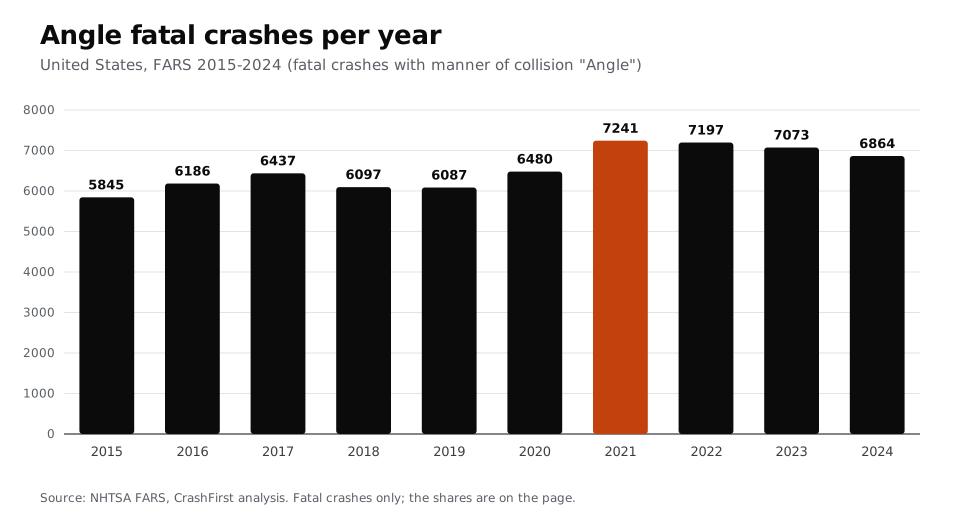
Angle fatal crashes ranged from 5,845 (2015) to 7,241 (2021). The chart shows exactly the counts in our data file.
Where angle crashes happen
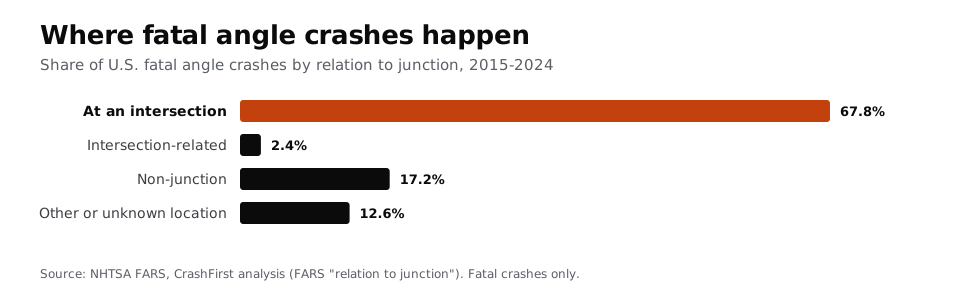
Of 65,507 angle fatal crashes, 44,442 (67.8%) were coded "at an intersection" and 1,547 (2.4%) "intersection-related." Another 11,271 (17.2%) were not at a junction at all, and 8,247 (12.6%) had another or unknown location.
Our four states
| State | All fatal crashes | Angle | Share |
|---|---|---|---|
| Tennessee | 10,680 | 2,116 | 19.8% |
| Alabama | 8,797 | 1,418 | 16.1% |
| Oklahoma | 6,172 | 1,372 | 22.2% |
| South Carolina | 9,692 | 1,657 | 17.1% |
Source for all tables: NHTSA FARS 2015-2024 accident files, analysed by CrashFirst. Counts are crashes, not people. For comparison, front-to-rear crashes were 7.1% (rear-end collisions).
Injury research
Side-impact injury research
The Insurance Institute for Highway Safety (IIHS) reports that "Side impacts accounted for 23 percent of passenger vehicle occupant deaths in 2018." [12] IIHS also reports that a 2011 study of ten years of crash data "found that a driver of a vehicle rated good is 70 percent less likely to die in a left-side crash than a driver of a vehicle rated poor." [12]
IIHS notes that NHTSA's older barrier test "doesn't reflect the much greater risk of head injury from impacts with taller vehicles." [12]
These are fatality statistics for occupants of passenger vehicles in general, not predictions about any crash. A person hurt in a side impact should see a doctor; the pages on neck and back pain and concussion and brain injury explain what to watch for. We cannot diagnose anyone.
Causes
What drives intersection crashes
NHTSA studied intersection-related crashes using on-scene investigations. It reports that crashes often occur at intersections because "these are the locations where two or more roads cross each other" and turning left, crossing over and turning right create conflicts [13]. Of the intersection-related crashes with a driver-attributed critical reason, the most frequent was inadequate surveillance (44.1%) [13].
NHTSA is careful about what that number means: a critical reason is subjective and "may not be the cause of the crash nor does it imply the assignment of fault." [13] The study uses 2005 to 2007 data, so treat it as research context, not a current rate. For more on causes, see common causes of car accidents.
What to do after one
After a side-impact crash
The longer checklist is on what to do after a car accident. Lawsuit deadlines differ by state: use the deadline calculator.
Want to talk it through? A person usually calls you back in about 15 minutes (8am to 8pm Central). You never pay CrashFirst. CrashFirst is not a law firm, does not evaluate your crash and does not give legal advice. General information as of November 9, 2026.
Sources
- Tenn. Code Ann. § 55-8-110, traffic-control signals (FindLaw mirror, current as of Jan. 2, 2024) (checked November 9, 2026)Code text via FindLaw (unofficial copy)“shall yield the right-of-way to other vehicles and to pedestrians lawfully within the intersection”“shall stop before entering the crosswalk on the near side of the intersection”
- Tenn. Code Ann. § 55-8-129, vehicle turning left (FindLaw mirror) (checked November 9, 2026)Code text via FindLaw (unofficial copy)“shall yield the right-of-way to any vehicle approaching from the opposite direction which is within the intersection or so close thereto as to constitute an immediate hazard”
- Tenn. Code Ann. § 55-8-130, stop and yield signs (FindLaw mirror) (checked November 9, 2026)Code text via FindLaw (unofficial copy)“shall proceed cautiously, yielding to vehicles not so obliged to stop which are within the intersection or approaching so closely as to constitute an immediate hazard”
- Code of Alabama § 32-5A-32, traffic-control signal legend (Alabama Legislature) (checked November 9, 2026)Official source“shall yield the right-of-way to other vehicles and to pedestrians lawfully within the intersection”“shall stop at a clearly marked stop line”
- Code of Alabama § 32-5A-111, vehicle turning left (Alabama Legislature) (checked November 9, 2026)Official source“shall yield the right-of-way to any vehicle approaching from the opposite direction which is within the intersection or so close thereto as to constitute an immediate hazard”
- Code of Alabama § 32-5A-112, stop or yield intersection (Alabama Legislature) (checked November 9, 2026)Official source“shall yield the right-of-way to any vehicle in the intersection or approaching on another roadway so closely as to constitute an immediate hazard”“such collision shall be deemed prima facie evidence of his or her failure to yield right-of-way”
- 47 O.S. § 11-202, traffic-control signal legend (Oklahoma State Courts Network) (checked November 9, 2026)Official source“shall yield the right-of-way to other vehicles and to pedestrians lawfully within the intersection”“shall stop at a clearly marked stop line”
- 47 O.S. § 11-402, vehicle turning left (Oklahoma State Courts Network) (checked November 9, 2026)Official source“shall yield the right-of-way to any vehicle approaching from the opposite direction which is so close thereto when initiating such turn as to constitute an immediate hazard”
- 47 O.S. § 11-403, stop or yield intersection (Oklahoma State Courts Network) (checked November 9, 2026)Official source“shall yield the right-of-way to any vehicle which has entered the intersection from another highway or which is approaching so closely on said highway as to constitute an immediate hazard”“such collision shall be deemed prima facie evidence of his failure to yield right of way”
- S.C. Code Title 56, Chapter 5 (§§ 56-5-970, 56-5-2320, 56-5-2330) (South Carolina Legislature) (checked November 9, 2026)Official source“shall yield the right-of-way to other vehicles and to pedestrians lawfully within the intersection”“shall stop at a clearly marked stop line”“the driver shall yield the right-of-way to any vehicle in the intersection or approaching on another roadway so closely as to constitute an immediate hazard”“the collision shall be deemed prima facie evidence of his failure to yield right-of-way”“shall yield the right-of-way to any vehicle approaching from the opposite direction which is within the intersection or so close thereto as to constitute an immediate hazard”
- NHTSA, final rule on side impact protection for child seats (describes the T-bone crash) (checked November 9, 2026)Official source“commonly known as a T-bone crash”
- IIHS, IIHS prepares to launch new, more challenging side crash test (checked November 9, 2026)Official source“Side impacts accounted for 23 percent of passenger vehicle occupant deaths in 2018.”“a driver of a vehicle rated good is 70 percent less likely to die in a left-side crash than a driver of a vehicle rated poor”“doesn't reflect the much greater risk of head injury from impacts with taller vehicles”
- NHTSA, Crash Factors in Intersection-Related Crashes: An On-Scene Perspective (DOT HS 811 366) (checked November 9, 2026)Official sourceWhere: p.1, IntroductionWhere: p.5, text above Figure 7Where: p.5, Critical reason definition
- NHTSA, Fatality Analysis Reporting System (FARS), 2015-2024 national files (checked November 9, 2026)Official source“FARS is a nationwide census providing NHTSA, Congress and the American public yearly data regarding fatal injuries suffered in motor vehicle traffic crashes”
Unofficial copies come from a legal publisher, not the state. They can lag the current code, so check the official code before relying on a date or amount.
Page last updated November 9, 2026. Attorney review pending. General information, not legal advice. Fees, hours and rules change; confirm on the official page. How we source.
Questions
What is a T-bone crash?
A T-bone crash is a side-impact crash: the front of one vehicle strikes the side of another, forming a T. NHTSA describes its side-impact child-seat test as replicating a 30-mph side collision, "commonly known as a T-bone crash." [11] In federal fatal-crash data the closest category is "Angle."
What is considered an intersection accident?
There is no single legal definition on this page. NHTSA describes intersections as the locations where two or more roads cross each other, where turning left, crossing over and turning right create conflicts [13]. In FARS, a crash is coded by its relation to the junction: at an intersection, intersection-related (for example, near one), or not at a junction.
What is the main cause of intersection accidents?
Federal research does not name one cause. In NHTSA's on-scene study, the most frequently assigned driver-attributed critical reason in intersection-related crashes was inadequate surveillance, 44.1% of those crashes [13]. NHTSA warns that a critical reason may not be the cause of the crash nor imply fault [13].
CrashFirst is not a law firm and does not give legal advice. This checklist is general information. Every situation is different.
Keep reading
- Guide
What to do after a crash.
A calm, ordered checklist for the scene, today, the next 72 hours and the next few weeks. Tick it off here or print it for the glove box.
Open - Guide
Rear-end collision: what the law says and what to do.
What the following-too-closely laws of Tennessee, Alabama, Oklahoma and South Carolina say, how often federal data records front-to-rear fatal crashes, and what to do after.
Open - Guide
Neck and back pain after a car accident: what health sources say.
What MedlinePlus and AAOS OrthoInfo say about neck injury, whiplash, back pain and sciatica after a crash, and the signs that mean call 911 or see a doctor.
Open - Guide
Headache, concussion and TBI after a car accident: what health sources say.
What the CDC, NINDS and MedlinePlus say about headache, concussion and traumatic brain injury after a crash: symptoms, danger signs and when to get care.
Open - Tool
Find your crash report.
Pick where the crash happened in Memphis, Birmingham, Tulsa or Columbia to see which agency likely has your report and how to request it. Each row shows its source.
Open - Tool
See the usual filing deadline.
Enter your state and crash date to see the usual deadline to file, with the statute and the exceptions. Tennessee, Alabama, Oklahoma and South Carolina now; other states coming. Informational only.
Open