
The short answer
What the law says about rear-end collisions
A rear-end collision is a crash where the front of one vehicle hits the back of another. Tennessee, Alabama, Oklahoma and South Carolina each tell drivers not to follow another vehicle "more closely than is reasonable and prudent." [1] Federal data codes 7.1% of U.S. fatal crashes from 2015 to 2024 as front-to-rear.
This page reports what the statutes say and what the federal numbers show. It does not say who is at fault in any crash, and it does not predict what a claim is worth.

The statutes
Following too closely: four states
Each row is the general rule as written. All four have longer sections with extra rules for trucks, caravans and similar cases, which we do not cover here. Tennessee text is as reproduced by FindLaw, current as of January 2, 2024; Alabama, Oklahoma and South Carolina were read on the state legislature or court-network sites on November 9, 2026.
| State | Section | The general rule |
|---|---|---|
| Tennessee | Tenn. Code Ann. § 55-8-124(a) | "The driver of a motor vehicle shall not follow another vehicle more closely than is reasonable and prudent, having due regard for the speed of the vehicles and the traffic upon and the condition of the highway." [1] A violation is a Class C misdemeanor [1]. |
| Alabama | Ala. Code § 32-5A-89(a) | Same reasonable-and-prudent rule, plus a distance: "Except when overtaking and passing another vehicle, the driver of a vehicle shall leave a distance of at least 20 feet for each 10 miles per hour of speed" between the two vehicles [2] [2]. |
| Oklahoma | 47 O.S. § 11-310(a) | "The driver of a motor vehicle shall not follow another vehicle more closely than is reasonable and prudent, having due regard for the speed of such vehicles and the traffic upon and the condition of the highway." [3] |
| South Carolina | S.C. Code § 56-5-1930(A) | "The operator of a motor vehicle shall not follow another vehicle more closely than is reasonable and prudent, having due regard for the speed of such vehicles and the traffic upon and the condition of the highway." [4] |
Alabama's 20-feet-per-10-mph figure is the only fixed following distance in these four general rules. At 60 mph that formula works out to 120 feet. Whether a particular driver met any of these rules is a question of facts, not something this page can answer.
Fault
What these laws do not tell you
The statutes above set a duty for the driver who follows. They do not say that a driver who rear-ends another is automatically responsible, and we have not found, and so do not state, any rule of that kind in the sources we read. Whether another driver also shares fault, and what that does to a claim, depends on each state's fault rules:
- Tennessee: fault rules
- Alabama: contributory negligence
- Oklahoma: fault rules
- South Carolina: see the South Carolina pages
An attorney can explain how those rules apply to your facts.
The numbers
How many fatal crashes are front-to-rear
NHTSA's Fatality Analysis Reporting System (FARS) is described by NHTSA as "a nationwide census providing NHTSA, Congress and the American public yearly data regarding fatal injuries suffered in motor vehicle traffic crashes." [5] It codes a "manner of collision" for each fatal crash. "Front-to-Rear" is the category that matches a rear-end crash. We counted it in the 2015 to 2024 national files. These are fatal crashes only: most rear-end crashes are not fatal and are not in FARS at all.
| Year | All U.S. fatal crashes | Front-to-rear | Share |
|---|---|---|---|
| 2015 | 32,538 | 2,225 | 6.8% |
| 2016 | 34,748 | 2,372 | 6.8% |
| 2017 | 34,560 | 2,473 | 7.2% |
| 2018 | 33,919 | 2,459 | 7.2% |
| 2019 | 33,487 | 2,363 | 7.1% |
| 2020 | 35,935 | 2,441 | 6.8% |
| 2021 | 39,785 | 2,971 | 7.5% |
| 2022 | 39,422 | 2,830 | 7.2% |
| 2023 | 37,769 | 2,715 | 7.2% |
| 2024 | 36,297 | 2,603 | 7.2% |
| 2015-2024 | 358,460 | 25,452 | 7.1% |
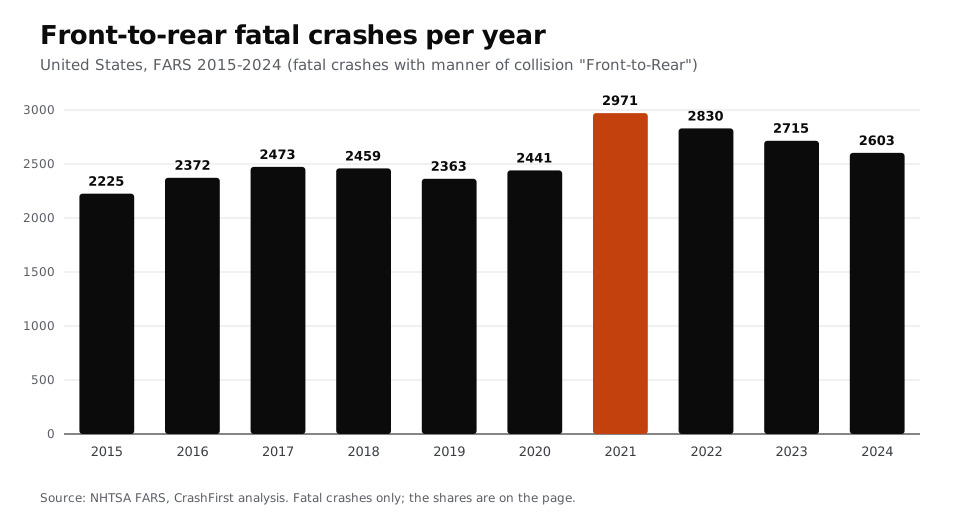
Front-to-rear fatal crashes ranged from 2,225 (2015) to 2,971 (2021); the share stayed between 6.8% and 7.5%. Those crashes killed 28,047 people over the ten years. The chart shows exactly the counts in our data file.
Our four states
| State | All fatal crashes | Front-to-rear | Share |
|---|---|---|---|
| Tennessee | 10,680 | 736 | 6.9% |
| Alabama | 8,797 | 611 | 6.9% |
| Oklahoma | 6,172 | 466 | 7.6% |
| South Carolina | 9,692 | 717 | 7.4% |
Source for all tables: NHTSA FARS 2015-2024 accident files, analysed by CrashFirst. Counts are crashes, not people, except the 28,047 deaths above.
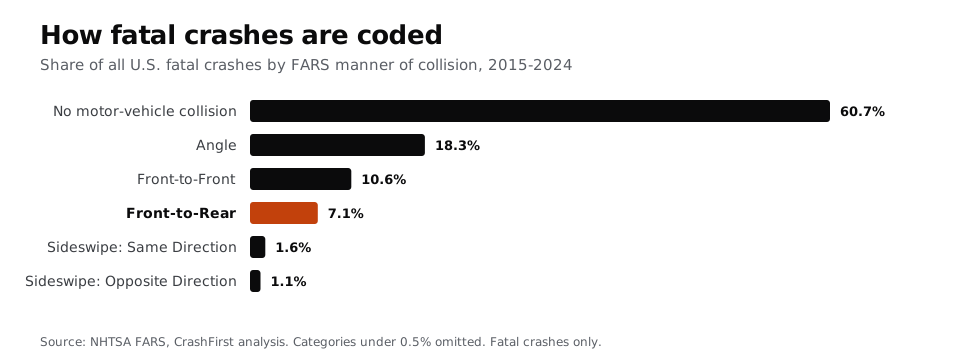
For comparison, the chart shows how FARS codes all fatal crashes: most (60.7%) involve no collision with another moving motor vehicle at all, and angle crashes (T-bone and side-impact) are 18.3%, more than twice the front-to-rear share.
What to do after one
After a rear-end crash
The longer checklist is on what to do after a car accident.
Insurance and deadlines
Claims, settlements and deadlines
Two things we can state, and one we cannot. We can state how insurers say the process starts: NAIC says the insurer assigns a claims adjuster, and that you should cooperate with the adjuster's investigation [6]. We can state that if you disagree with an offer, NAIC says to try to resolve it with your insurer and, failing that, to ask your state insurance department for help [6].
We cannot say how long a rear-end claim takes to settle or what a fair amount is. Both depend on facts this page does not have, and we do not estimate case value. What does have a fixed date is the lawsuit deadline, which differs by state: use the deadline calculator or the state-by-state deadline table.
Want to talk it through? A person usually calls you back in about 15 minutes (8am to 8pm Central). You never pay CrashFirst. CrashFirst is not a law firm, does not evaluate your crash and does not give legal advice. General information as of November 9, 2026.
Sources
- Tenn. Code Ann. § 55-8-124, following too closely (FindLaw mirror, current as of Jan. 2, 2024) (checked November 9, 2026)Code text via FindLaw (unofficial copy)“shall not follow another vehicle more closely than is reasonable and prudent”“shall not follow another vehicle more closely than is reasonable and prudent, having due regard for the speed of the vehicles”“A violation of this section is a Class C misdemeanor”
- Code of Alabama § 32-5A-89, following too closely (Alabama Legislature) (checked November 9, 2026)Official source“shall not follow another more closely than is reasonable and prudent”“shall leave a distance of at least 20 feet for each 10 miles per hour of speed”
- 47 O.S. § 11-310, following too closely (Oklahoma State Courts Network) (checked November 9, 2026)Official source“shall not follow another vehicle more closely than is reasonable and prudent, having due regard for the speed of such vehicles”
- S.C. Code § 56-5-1930, following too closely (South Carolina Legislature, Title 56, Chapter 5) (checked November 9, 2026)Official source“shall not follow another vehicle more closely than is reasonable and prudent, having due regard for the speed of such vehicles”
- NHTSA, Fatality Analysis Reporting System (FARS), 2015-2024 national files (checked November 9, 2026)Official source“FARS is a nationwide census providing NHTSA, Congress and the American public yearly data regarding fatal injuries suffered in motor vehicle traffic crashes”
- NAIC, What You Should Know About Filing an Auto Claim (checked November 9, 2026)Official source“Call 911 if someone is injured.”“Get his or her name, address, and insurance company's name and phone number.”“Take a photo or sketch a diagram of the accident scene.”“call the phone number on your proof-of-insurance card as soon as possible”“You should cooperate with the adjuster's investigation of your claim.”“you should ask for help from the consumer services personnel at your state insurance department”“To file a claim, call the phone number on your proof-of-insurance card as soon as possible”“The insurance company will assign a claims adjuster to assess the damage and determine the payment”“You don't have to accept a payment you don't feel is fair.”“ask the adjuster to provide a written explanation of the decisions he or she makes”
Unofficial copies come from a legal publisher, not the state. They can lag the current code, so check the official code before relying on a date or amount.
Page last updated November 9, 2026. Attorney review pending. General information, not legal advice. Fees, hours and rules change; confirm on the official page. How we source.
Questions
Whose fault is it in a rear-end collision?
This page cannot say whose fault a particular crash is. Each of the four states we cover has a statute telling a driver not to follow another vehicle more closely than is reasonable and prudent, [1] but fault is decided from the facts of the crash by insurers, and by a court if it goes that far. How fault is shared differs by state: see the fault rules for Tennessee, Alabama and Oklahoma linked on this page.
How does insurance work if you get rear-ended?
NAIC, the association of state insurance regulators, says to call the number on your proof-of-insurance card as soon as possible, and that the insurer will assign a claims adjuster to assess the damage and determine the payment [6] [6]. Which coverage pays depends on your policy and on who is at fault; the policy, not this page, answers that.
How long does a rear-end collision settlement take?
This page cannot predict that, and neither can any general article: it depends on the injuries, the insurers and the facts. What we can point to is the one clock that does not move: lawsuit deadlines. They differ by state, and the usual Tennessee deadline is one year, so check yours on the deadline calculator.
What is a fair settlement for a rear-end collision?
This page cannot give a dollar figure and does not evaluate any crash. NAIC says you do not have to accept a payment you do not feel is fair, and that if you disagree you can ask the adjuster for a written explanation and then contact your state insurance department [6] [6].
Can a rear-end collision cause lower back pain?
Back and neck pain after a crash is common enough that we wrote a separate page on it. We cannot diagnose anyone. If you hurt after a crash, see a doctor, and call 911 or go to an emergency room for severe symptoms. See neck and back pain after a car accident.
How common are rear-end crashes?
In NHTSA's FARS files for 2015 to 2024, 25,452 of 358,460 U.S. fatal crashes (7.1%) have a manner of collision of Front-to-Rear. FARS counts only crashes where someone died, so it says little about how many rear-end crashes happen overall.
CrashFirst is not a law firm and does not give legal advice. This checklist is general information. Every situation is different.
Keep reading
- Guide
What to do after a crash.
A calm, ordered checklist for the scene, today, the next 72 hours and the next few weeks. Tick it off here or print it for the glove box.
Open - Guide
Neck and back pain after a car accident: what health sources say.
What MedlinePlus and AAOS OrthoInfo say about neck injury, whiplash, back pain and sciatica after a crash, and the signs that mean call 911 or see a doctor.
Open - Guide
T-bone accident: what it is and who has the right of way.
What a T-bone (side-impact or angle) crash is, the right-of-way rules in Tennessee, Alabama, Oklahoma and South Carolina, and what federal data shows about angle crashes.
Open - Tool
Find your crash report.
Pick where the crash happened in Memphis, Birmingham, Tulsa or Columbia to see which agency likely has your report and how to request it. Each row shows its source.
Open - Guide
How to get your medical records and bills after a car crash
HIPAA gives you access to your records in 30 days at a reasonable cost-based fee. Tennessee copy fees, itemized bills and a request checklist.
Open - Tool
See the usual filing deadline.
Enter your state and crash date to see the usual deadline to file, with the statute and the exceptions. Tennessee, Alabama, Oklahoma and South Carolina now; other states coming. Informational only.
Open