The short answer
What a dram shop law is
A dram shop is "a commercial establishment that sells alcoholic beverages" [1]. Dram shop laws "hold alcohol-serving businesses" [1] liable when they serve visibly intoxicated or underage patrons who later cause harm. Cornell's Legal Information Institute adds that these laws are usually based on negligence, not strict liability, and that most jurisdictions limit them to harm suffered by others [1].
Whether a particular state has such a law, and what it requires, is set by that state. The four launch states differ, as the table shows. This is general information as of November 9, 2026, not legal advice.
By state
Dram shop rules in Tennessee, Alabama, Oklahoma and South Carolina
| State | Source of the rule | What the text requires |
|---|---|---|
| Tennessee | Tenn. Code Ann. §§ 57-10-101 and 57-10-102 | Jury must find beyond a reasonable doubt the sale was the proximate cause and the seller sold to a minor known to be under 21 or to a visibly intoxicated person [3]. |
| Alabama | Ala. Code § 6-5-71 (amended by Act 2023-25) | Right of action against a person who knowingly sold, furnished or served a visibly intoxicated individual, where that is the proximate cause [4]. |
| Oklahoma | Court decisions (Brigance, 1986; MeGee, 2023); 37A O.S. §§ 6-101, 6-121 bar the service | Court recognizes third-party claims against a commercial vendor that over-served a driver; no civil statute found [8]. |
| South Carolina | S.C. Code §§ 61-4-580, 61-2-145 | Statutes bar knowing sales to an intoxicated person and require liquor liability insurance for certain on-premises sellers; no civil cause of action stated in them [9]. |
Damage caps: none of the statutes quoted on this page states a cap on damages. Alabama's text refers to "all damages actually sustained as well as exemplary damages" [4]. Our reading is limited to the sections cited; other parts of each state's code and case law can matter and we did not review them.
Tennessee
Tennessee
The legislature's starting point is a finding: "the consumption of any alcoholic beverage or beer rather than the furnishing of any alcoholic beverage or beer is the proximate cause of injuries inflicted upon another by an intoxicated person." [2] Section 57-10-102 then sets the exception. No judge or jury may award damages against a seller "unless such jury of twelve (12) persons has first ascertained beyond a reasonable doubt" [3] that the sale was the proximate cause of the injury or death and that the seller either "Sold the alcoholic beverage or beer to a person known to be under the age of twenty-one (21) years" [3] or "Sold the alcoholic beverage or beer to a visibly intoxicated person" [3], and that person caused the injury or death as the direct result of consuming what was sold. Statute text is from the FindLaw mirror, current as of January 2, 2024.
Alabama
Alabama
Section 6-5-71(a)(1) starts by saying a seller "shall not thereby become liable for injury, death, or damage caused by or resulting from the intoxication" [4] of an individual of lawful drinking age. It then gives a right of action to anyone injured in person, property or means of support by an intoxicated individual against a person who "knowingly sells, furnishes, or serves alcoholic beverages" [4] to a visibly intoxicated individual when that is the proximate cause. "Knowingly" means "knew or should have known under the circumstances." [4] On proof, the section says visible intoxication is judged on "the totality of the circumstances present at the time of service of the alcoholic beverages" [4]. The section also says the injured person "may commence a joint or separate action against the individual intoxicated or the person who furnished the alcoholic beverages" [4].
The legislature's note to Act 2023-25 says it intended to replace a strict-liability standard and not "to broaden liability to social hosts for serving alcoholic beverages to an individual 21 years of age or older" [5].
Oklahoma
Oklahoma
Oklahoma's civil rule comes from the courts. In MeGee v. El Patio (2023 OK 14) the Oklahoma Supreme Court wrote that "The common law rule was that a liquor vendor is not civilly liable for injuries to a third party that are caused by the acts of an intoxicated patron." [8] It then described the change: "a third party injured by a drunk driver may state a cause of action against the commercial vendor that over-served the driver" [8]. A separate opinion in the same case says that "the civil liability created by" [8] that earlier decision has not been written into statute by the legislature; we read that as a judge's view, not a holding.
The statute 37A O.S. § 6-101 provides that no person shall "Sell, deliver or knowingly furnish alcoholic beverages to an intoxicated person" [6]. Section 6-121 makes knowingly doing so a misdemeanor for a first violation, "a Class D3 felony offense" [7] for a later one, and requires the ABLE Commission to revoke the license of a person convicted. These are criminal and licensing rules, not a civil damages statute.
South Carolina
South Carolina
Two statutes apply to sellers. Section 61-4-580 says a beer or wine permit holder, or an employee, may not "knowingly commit any of the following acts" [9], including to "sell beer or wine to an intoxicated person" [9]. A version effective January 1, 2026 adds "In addition to civil liability as provided by law" [9] penalties from the department: a $2,500 fine for a first offense, up to a 14-day suspension for a second offense within two years, and revocation for a third within three. Section 61-2-145 requires a permit or license holder selling for on-premises consumption after 5 p.m. to maintain a liquor liability policy [10], unless it qualifies under a risk mitigation program. Those sections set licensing and insurance duties; neither states a civil action by an injured person. We did not review South Carolina case law, so we cannot say how courts treat such claims.
What to write down
After a crash with an impaired driver
Federal data
How common are drunk-driver deaths?
NHTSA: "About 30% of all traffic crash fatalities in the United States involve drunk drivers" [11] (BAC of .08 g/dL or higher). NHTSA reports that "In 2024, there were 11,904 people killed" [11] in these crashes, and "one person was killed in a drunk-driving crash every 44 minutes" [11]. NHTSA also says "Drivers with a BAC of .08 are approximately 4 times more likely to crash than drivers with a BAC of zero." [11]
We also counted deaths in fatal crashes from the Fatality Analysis Reporting System (FARS), which covers fatal crashes only ("FARS is a nationwide census providing NHTSA, Congress and the American public yearly data regarding fatal injuries suffered in motor vehicle traffic crashes." [12]). Our count includes only crashes where at least one driver has a recorded test result of .08 or higher, so it is lower than NHTSA's published totals and the two should not be compared. It is a floor, not a full count.
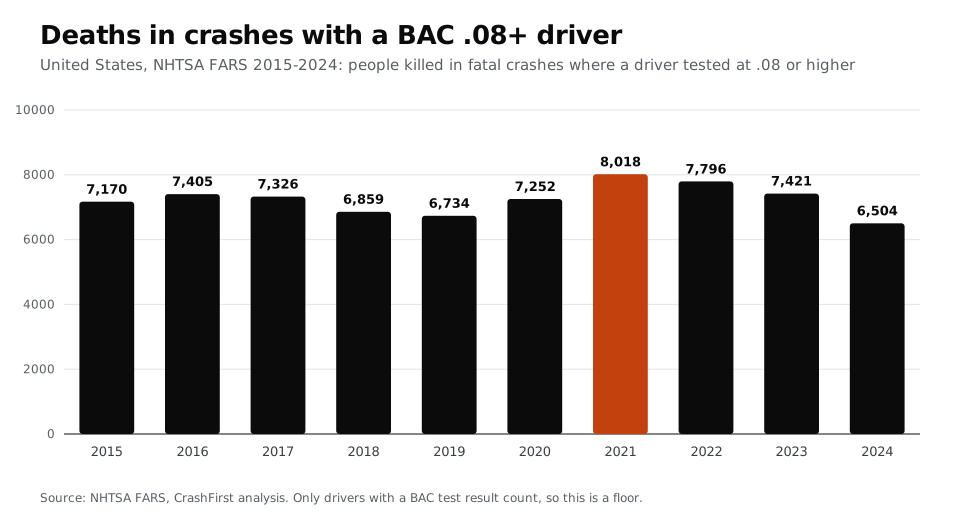
The chart shows exactly the counts in our data file. The tested-driver count peaked at 8,018 in 2021 and was 6,504 in 2024.
| State (FARS, 2015-2024) | All people killed in fatal crashes | Killed in crashes with a tested .08+ driver | Share |
|---|---|---|---|
| Tennessee | 11,576 | 2,028 | 17.5% |
| Alabama | 9,605 | 1,716 | 17.9% |
| Oklahoma | 6,765 | 1,384 | 20.5% |
| South Carolina | 10,473 | 2,565 | 24.5% |
Source: NHTSA FARS, CrashFirst analysis; data file and method in the page's dataset notes [12]. Shares depend on how often drivers are tested in each state, so differences between states may reflect testing practice, and this table is not a ranking.
Next steps
Related pages
- What to do after a car accident
- If the driver who hit you left and whether that is a felony
- Car accident deadlines by state
- Car accident statistics by state
Want to talk it through? A person usually calls you back in about 15 minutes (8am to 8pm Central). You never pay CrashFirst. CrashFirst is not a law firm, does not evaluate your crash and does not give legal advice. An attorney can explain how a dram shop statute applies to your facts. General information as of November 9, 2026.
Sources
- Cornell Legal Information Institute (Wex): dram shop rule (checked November 9, 2026)Official source“a commercial establishment that sells alcoholic beverages”“hold alcohol-serving businesses”“These laws are usually based on”“when they serve visibly intoxicated or underage patrons who later cause harm”
- Tenn. Code Ann. § 57-10-101, legislative finding (FindLaw mirror, current as of Jan. 2, 2024) (checked November 9, 2026)Code text via FindLaw (unofficial copy)“the consumption of any alcoholic beverage or beer rather than the furnishing of any alcoholic beverage or beer is the proximate cause of injuries inflicted upon another by an intoxicated person.”
- Tenn. Code Ann. § 57-10-102, civil liability of sellers (FindLaw mirror, current as of Jan. 2, 2024) (checked November 9, 2026)Code text via FindLaw (unofficial copy)“Sold the alcoholic beverage or beer to a visibly intoxicated person”“unless such jury of twelve (12) persons has first ascertained beyond a reasonable doubt”“Sold the alcoholic beverage or beer to a person known to be under the age of twenty-one (21) years”“a person known to be under the age of twenty-one (21) years”“a visibly intoxicated person”
- Ala. Code § 6-5-71, right of action for injuries from furnishing alcohol (Alabama Legislature) (checked November 9, 2026)Official source“who was visibly intoxicated, when the sale, furnishing, or serving is the proximate cause of such injury or damage”“all damages actually sustained as well as exemplary damages”“shall not thereby become liable for injury, death, or damage caused by or resulting from the intoxication”“knowingly sells, furnishes, or serves alcoholic beverages”“knew or should have known under the circumstances”“the totality of the circumstances present at the time of service of the alcoholic beverages”“may commence a joint or separate action against the individual intoxicated or the person who furnished the alcoholic beverages”
- Ala. Code § 6-5-71.1, legislative intent (Alabama Legislature) (checked November 9, 2026)Official source“to broaden liability to social hosts for serving alcoholic beverages to an individual 21 years of age or older”
- 37A O.S. § 6-101, prohibited acts (Oklahoma State Courts Network) (checked November 9, 2026)Official source“Sell, deliver or knowingly furnish alcoholic beverages to an intoxicated person”
- 37A O.S. § 6-121, penalties for serving an intoxicated person (Oklahoma State Courts Network) (checked November 9, 2026)Official source“a Class D3 felony offense”
- MeGee v. El Patio, 2023 OK 14, 524 P.3d 1283 (Oklahoma Supreme Court, via OSCN) (checked November 9, 2026)Official source“a third party injured by a drunk driver may state a cause of action against the commercial vendor that over-served the driver”“The common law rule was that a liquor vendor is not civilly liable for injuries to a third party that are caused by the acts of an intoxicated patron.”“the civil liability created by”
- S.C. Code § 61-4-580, prohibited acts of beer and wine permit holders (South Carolina Legislature) (checked November 9, 2026)Official source“sell beer or wine to an intoxicated person”“knowingly commit any of the following acts”“In addition to civil liability as provided by law”“an intoxicated person”“civil liability as provided by law”
- S.C. Code § 61-2-145, liability insurance for on-premises sellers (South Carolina Legislature) (checked November 9, 2026)Official source“with an annual aggregate limit of at least one million dollars”
- NHTSA: Drunk Driving (page published Feb. 20, 2026; 2024 data) (checked November 9, 2026)Official source“About 30% of all traffic crash fatalities in the United States involve drunk drivers”“In 2024, there were 11,904 people killed”“one person was killed in a drunk-driving crash every 44 minutes”“Drivers with a BAC of .08 are approximately 4 times more likely to crash than drivers with a BAC of zero”
- NHTSA: Fatality Analysis Reporting System (FARS), 2015-2024 national files (checked November 9, 2026)Official source“FARS is a nationwide census providing NHTSA, Congress and the American public yearly data regarding fatal injuries suffered in motor vehicle traffic crashes.”Where: FARS 2015-2024 person.csv (ALC_RES) and accident.csv (FATALS), by state
Unofficial copies come from a legal publisher, not the state. They can lag the current code, so check the official code before relying on a date or amount.
Page last updated November 9, 2026. Attorney review pending. General information, not legal advice. Fees, hours and rules change; confirm on the official page. How we source.
Questions
What is a dram shop law?
Cornell's Legal Information Institute says dram shop laws "hold alcohol-serving businesses" [1] liable "when they serve visibly intoxicated or underage patrons who later cause harm." [1] A dram shop is a commercial establishment that sells alcoholic beverages, such as a bar or restaurant. Each state writes its own version.
What is the death rate of drunk driving?
NHTSA reports that "In 2024, there were 11,904 people killed" [11] in crashes involving drivers with a BAC of .08 g/dL or higher, about 30% of all U.S. traffic deaths, or one person killed every 44 minutes. We do not publish a per-mile or per-capita rate because we did not source one.
What state is number 1 for drunk driving?
We did not find a ranking from NHTSA or another primary source that we could verify, so we do not name a state. Raw counts by state mostly reflect population and driving. Our FARS counts for the four launch states are in the table above and are not a ranking.
Does Tennessee have a dram shop law?
Tennessee limits it tightly. A jury must find beyond a reasonable doubt that the sale was the proximate cause of the injury and that the seller sold to "a person known to be under the age of twenty-one (21) years" [3] or "a visibly intoxicated person" [3]. See the Tennessee section below.
Does Alabama have a dram shop law?
Yes. Ala. Code § 6-5-71 gives a right of action against a person who "knowingly sells, furnishes, or serves alcoholic beverages" [4] to a visibly intoxicated individual, where that service is the proximate cause of the injury. It defines knowingly as "knew or should have known under the circumstances" [4].
Does Oklahoma have a dram shop law?
Oklahoma's rule comes from court decisions, not a civil statute. The Oklahoma Supreme Court wrote in 2023 that since a 1986 case "a third party injured by a drunk driver may state a cause of action against the commercial vendor that over-served the driver." [8] State statute separately bars serving an intoxicated person.
Does South Carolina have a dram shop law?
The statutes we read regulate sellers but we did not find a civil cause of action in them. Section 61-4-580 bars permit holders from knowingly selling beer or wine to "an intoxicated person" [9], and it refers to "civil liability as provided by law" [9] without stating it. South Carolina case law was not read for this page.
Who can be responsible when a drunk driver hurts someone?
The driver is the first answer. In states with a dram shop law, a seller who served the driver may be too, but only when that state's conditions are met (see the table). Which parties are responsible in a particular crash is a question for an attorney.
CrashFirst is not a law firm and does not give legal advice. This checklist is general information. Every situation is different.
Keep reading
- Guide
What to do after a crash.
A calm, ordered checklist for the scene, today, the next 72 hours and the next few weeks. Tick it off here or print it for the glove box.
Open - Guide
What to do if you are hit by an uninsured driver
What to do if the other driver has no insurance, how uninsured motorist coverage reads in Tennessee, Alabama, Oklahoma and South Carolina, and how common uninsured drivers are. Sourced.
Open - Guide
What to do after a hit and run
Driver duties after a crash in Tennessee, Alabama, Oklahoma and South Carolina as the statutes read, who to report to, how uninsured motorist coverage treats a driver who left, and a checklist.
Open - Guide
Is hit and run a felony? What four state statutes say
What the statutes say about leaving the scene of a crash in Tennessee, Alabama, Oklahoma and South Carolina: when it is a felony, when a misdemeanor, quoted from the code.
Open - Tool
Find your crash report.
Pick where the crash happened in Memphis, Birmingham, Tulsa or Columbia to see which agency likely has your report and how to request it. Each row shows its source.
Open - Reference
Car accident injury deadlines: Tennessee, Alabama, Georgia, Mississippi, Oklahoma and South Carolina
Filing deadlines for car accident injury claims in Tennessee, Alabama, Georgia, Mississippi, Oklahoma and South Carolina, with statute citations. More states coming. Nov 2026.
Open